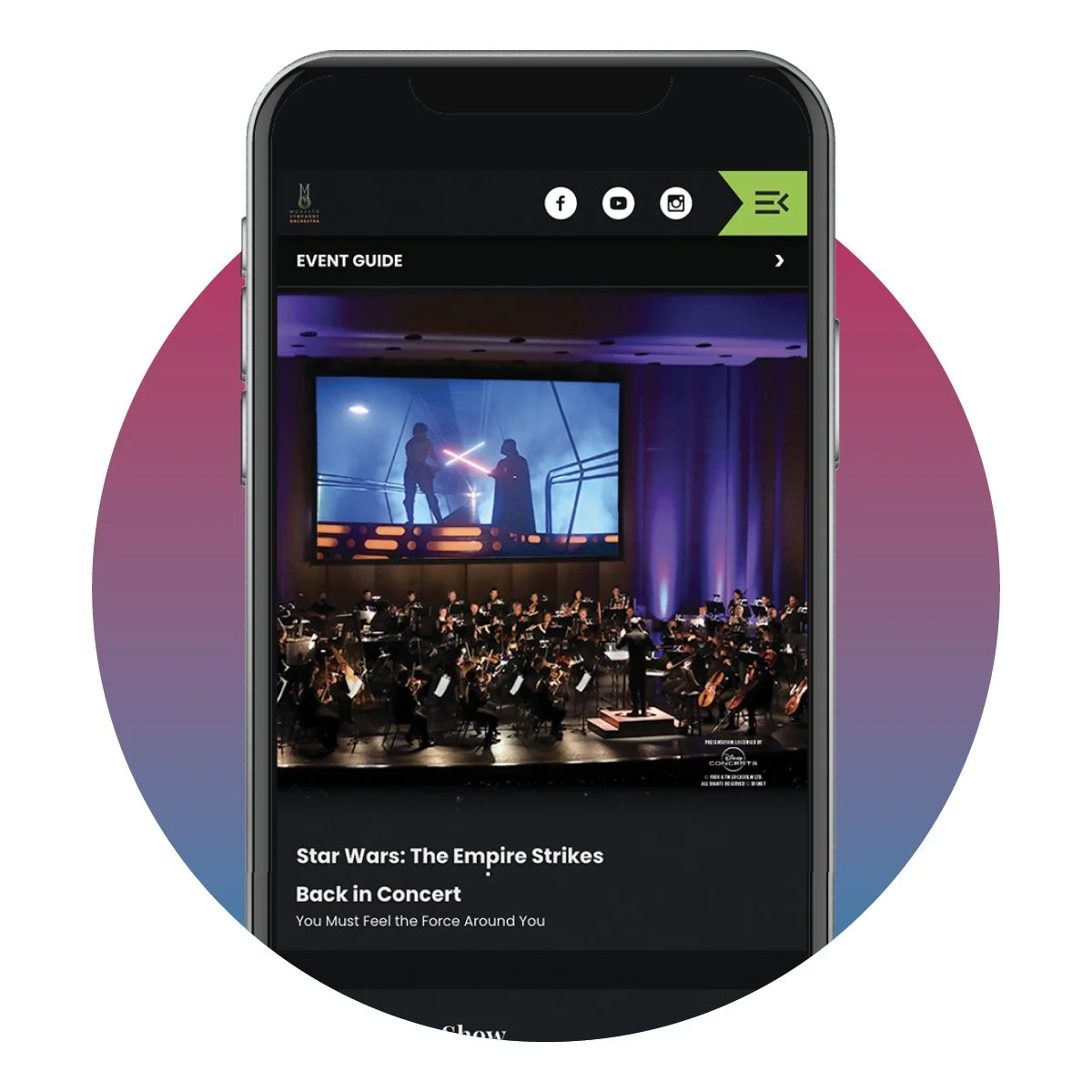
Star Wars: The Empire Strikes Back in Concert
June 2, 2023 at 7:30 pm
June 3, 2023 at 2:00 pm
Modesto Symphony Orchestra
Star Wars: The Empire Strikes Back in Concert
Friday, June 2, 2023 at 7:30 pm
Saturday, June 3, 2023 at 2:00 pm
Gallo Center for the Arts, Mary Stuart Rogers Theater

John Williams (b. 1932)
Star Wars: The Empire Strikes Back in Concert
Feature Film with Orchestra
There will be one intermission.
Presentation licensed by Disney Concerts in association with 20th Century Fox, Lucasfilm Ltd., and Warner/Chappell Music. All rights reserved.
Star Wars Film Concert Series
Star Wars: The Empire Strikes Back
Twentieth Century Fox Presents
A Lucasfilm Ltd. production
Starring
Mark Hamill
Harrison Ford
Carrie Fisher
Billy Dee Williams
Anthony Daniels
Co-Starring
David Prowse as Darth Vader
Kenny Baker as R2-D2
Peter Mayhew as Chewbacca
Frank Oz as Yoda
Directed By
Irvin Kershner
Produced By
Gary Kurtz
Screenplay by
Leigh Brackett and Lawrence Kasdan
Story by
George Lucas
Executive Producer
George Lucas
Music by
John Williams

Original Motion Picture Soundtrack available at Disneymusicemporium.com
Join Mobile MSO!
Text “EMPIRE” to (209) 780-0424
to receive a link to the concert program & text message updates prior to this performance!
By texting to this number, you may receive messages that pertain to the Modesto Symphony Orchestra and its performances. msg&data rates may apply. Reply HELP for help, STOP to cancel.
About this Performance


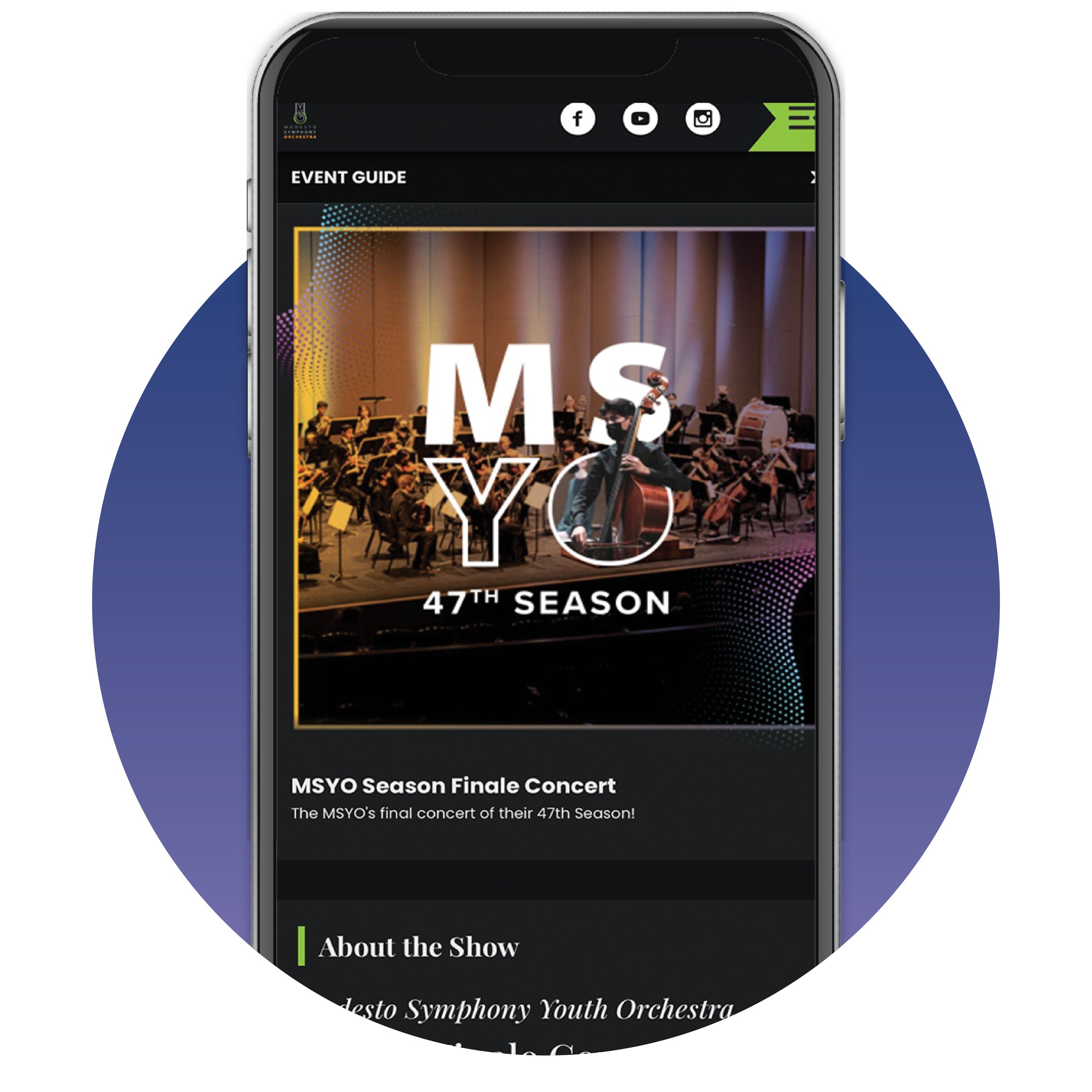
MSYO Season Finale Concert
May 13, 2023 at 2 pm
Modesto Symphony Youth Orchestra
Season Finale Concert
Saturday, May 13, 2023, 2:00pm
Gallo Center for the Arts, Mary Stuart Rogers Theater

Program
Concert Orchestra
Donald C. Grishaw, conductor
Johann Sebastian Bach (1685-1750)
Jesu, Joy of Man's Desiring arr. Merle Isaac
Mikhail Ippolitov-Ivanov (1859-1935)
Procession of the Sardar from Caucasian Sketches arr. Merle Isaac
Jose Padilla (1889-1960)
El Relicario arr. Merle Isaac
Woodwind Quintet
Edvard Grieg (1843-1907)
In the Hall of the Mountain King
Brass Ensemble
Klaus Badelt (b. 1967)
Pirates of the Caribbean arr. John Wasson
Percussion Ensemble
Chris Brooks (b. 1957)
Mambo Schmambo
Intermission
Honoring Seniors
Symphony Orchestra
Wayland Whitney, conductor
Gerónimo Giménez (1854-1923)
Intermedio from La Boda de Luís Alonso
Ernesto Lecuona (1895-1923)
Andalucia Suite arr. Gordon Jenkins
Jules Massenet (1842-1912)
Selections from Le Cid Suite
III. Aragonaise
VII. Navarraise
Join Mobile MSO!
Text “MSYO” to (209) 780-0424
to receive a link to the concert program & text message updates prior to this performance!
By texting to this number, you may receive messages that pertain to the Modesto Symphony Orchestra and its performances. msg&data rates may apply. Reply HELP for help, STOP to cancel.
About this Performance

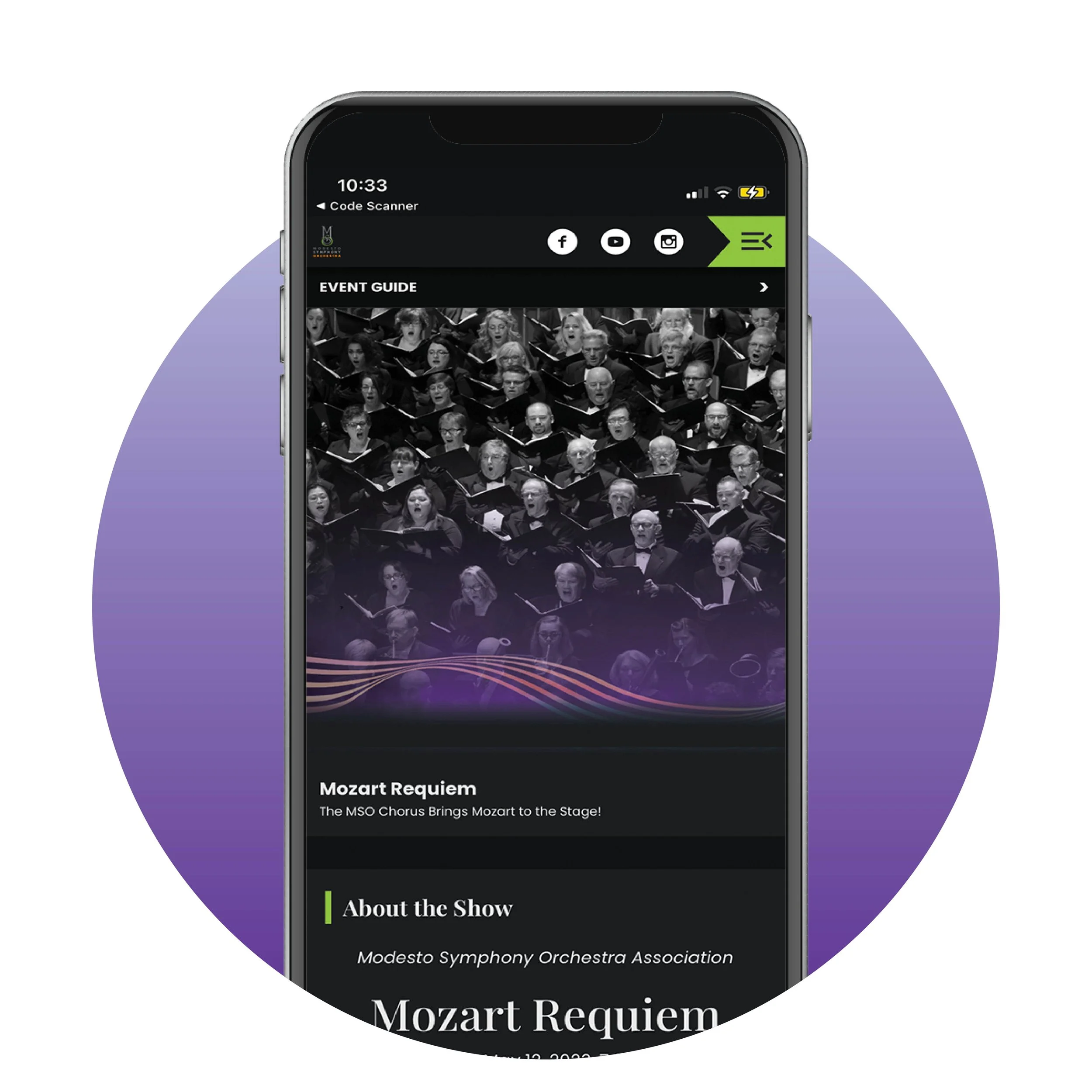
Mozart Requiem
February 10 & 11, 2023 at 7:30 pm
VISIT MOBILE PROGRAM →
READ OUR PROGRAM NOTES →
DOWNLOAD PRINTABLE VERSION (pdf, 3mb) →
Modesto Symphony Orchestra
Mozart Requiem
Friday, May 12, 2023 at 7:30 pm
Saturday, May 13, 2023 at 7:30 pm
Gallo Center for the Arts, Mary Stuart Rogers Theater
Anthony Parnther, conductor
MSO Chorus
Daniel R. Afonso Jr. , chorus director
Jennifer Lindsay, soprano
Maria Dominique Lopez, mezzo-soprano
Orson Van Gay, II, tenor
Zachary Gordin, baritone

Program
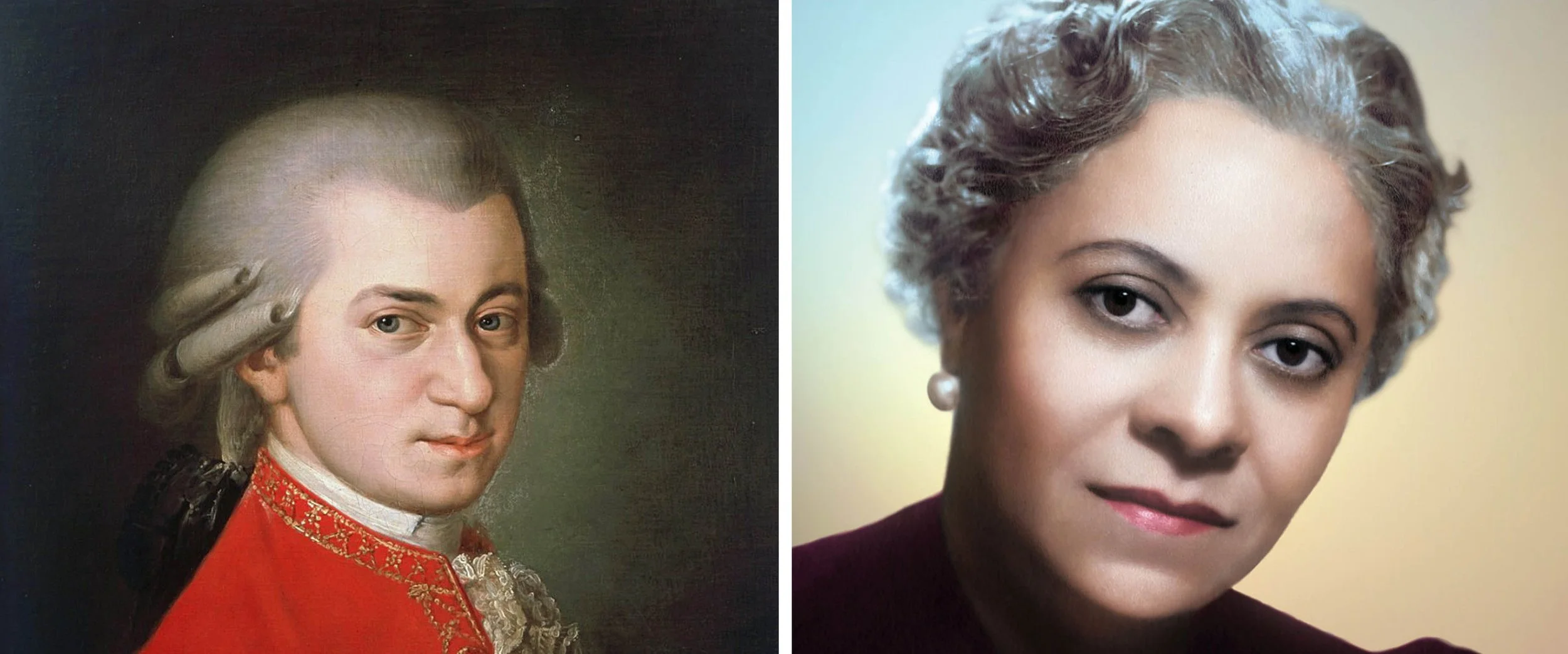
Wolfgang Amadeus Mozart (1756-1791)
Requiem, K. 626 (1791)
MSO Chorus
Daniel R. Afonso Jr., chorus director
Jennifer Lindsay, soprano
Maria Dominique Lopez, mezzo soprano
Orson Van Gay II, tenor
Zachary Gordin, baritone
- INTERMISSION -
Florence Price (1887-1953)
Symphony No. 3 in C minor (1938)
Andante
Andante ma non troppo
Juba: Allegro
Scherzo: Finale
Join Mobile MSO!
Text “PROGRAM” to (209) 780-0424
to receive a link to the concert program & text message updates prior to this performance!
By texting to this number, you may receive messages that pertain to the Modesto Symphony Orchestra and its performances. msg&data rates may apply. Reply HELP for help, STOP to cancel.
About this Performance
Program Notes: Mozart Requiem
Notes about:
Mozart’s Requiem, K. 626
Price’s Symphony No. 3 in C minor
Program Notes for MAy 12 & 13, 2023
Mozart Requiem
Wolfgang Amadeus Mozart
Requiem, K. 626 (completed by Robert Levin)

Composer: born January 27, 1756, Salzburg, Austria; died December 5, 1791, Vienna
Work composed: 1791. Mozart died before completing the Requiem, an anonymous commission from Count Franz Walsegg von Stuppach. The Requiem was originally finished by one of Mozart’s students, Franz Xaver Süssmayr. The version heard in these concerts was realized and completed by musicologist Robert Levin in 1991.
World premiere: Helmuth Rilling conducted the first performance of Levin’s realization in August 1991 at the European Music Festival in Stuttgart.
Instrumentation: soprano, alto, tenor and bass soloists, SATB chorus, 2 bassoons, 2 basset horns (or clarinets), 2 trumpets, 3 trombones, timpani, organ, and strings
Estimated duration: 53 minutes
The mysterious circumstances surrounding Wolfgang Amadeus Mozart’s Requiem have lent the work an aura of romance and intrigue almost as compelling as the music itself. In the summer of 1791, Count Franz Walsegg von Stuppach sent a messenger to Mozart with an anonymous commission for a Requiem intended to honor Walsegg’s late wife. Walsegg, an amateur musician, had a habit of commissioning works from well-known composers and then claiming them as his own, hence his need for anonymity and subterfuge. Chronically hard up, Mozart accepted the commission. He completed several sketches before putting the Requiem aside to finish Die Zauberflöte and La Clemenza di Tito and to oversee a production of Don Giovanni.
In October 1791, in failing health, Mozart returned to the Requiem. When Mozart died two months later, the Requiem remained unfinished. Mozart’s wife, Constanze, facing a mountain of debt, asked one of Mozart’s associates, Franz Xaver Süssmayr, to complete it. Süssmayr agreed, but his claims of authorship of the later movements of the Requiem have provoked sharp debates over which man wrote what, debates that continue today.
In 1991, musicologist Robert Levin presented his ‘completed’ version of the Requiem in which he corrected what he called Süssmayr’s “errors in musical grammar.” This version has become preferred by conductors and ensembles; since its premiere, there have been over 125 recordings of Levin’s edition.
The fine attention to detail in the meaning of the words of the requiem mass dictates the musical structure throughout. The chorus’ heartfelt pleading in the opening lines, “Requiem aeternam dona eis, Domine” (Grant them eternal rest, O God), are presented in a dark minor key. This is transformed into a promise of glowing eternity in the next sentence, “Et lux perpetua luceat eis” (and may perpetual light shine upon them) as the music moves into the light of a major key. The strong Kyrie (Lord, have mercy/Christ, have mercy) that follows is set in a stark fugue, Mozart’s homage to J. S. Bach.
The Sequence, which is composed of a number of short movements, begins with the Dies Irae (Day of Wrath), whose fiery, agitated setting and orchestral accompaniment bring the terror and fury of the text frighteningly alive. In the Tuba mirum, the bass soloist and a solo trombone proclaim the Day of Judgment, followed by each of the soloists in turn. The chorus returns to beg for salvation from hell in the powerful Rex tremendae, which is followed by the more intimate pleading of the Recordare, in which each of the soloists makes a personal petition to God. The gentleness of this movement is followed by the thunder of the Confutatis, which juxtaposes the images of the damned consigned to the flames of hell with that of the supplicant kneeling in prayer. Then comes the exquisite Lacrymosa, in which the chorus grieves and sobs; The sighing appoggiaturas of the violins echo the lamenting of the text. In the Offertory, the chorus ends its plea for mercy with a reminder of God’s promise to Abraham; these words are set into a tremendous fugue, which recurs at the end of the graceful Hostias.
With the Sanctus comes the first wholly joyful expression of emotion, as the chorus and orchestra together sing God’s praises with shining exclamations in the brasses and a fugue on the words “Hosanna in the highest.” The operatic grace of the melody of the Benedictus, sung by the four soloists, conveys the sense of blessedness of those “who come in the name of the Lord;” this is followed by a recurrence of the choral fugue from the Sanctus. With the Agnus Dei, the chorus and orchestra return to the darkly shifting mood of the opening movement; this culminates in the Communio, which uses the music of the opening Requiem aeternam and concludes with the same fugue used in the Kyrie, but this time on the words “cum sanctis tuis in aeternam” (with Thy saints forever).

Florence price
Symphony No. 3 in C minor

Composer: born April 9, 1887, Little Rock, AR; died June 3, 1953, Chicago
Work composed: 1938-39
World premiere: Valter Poole led the Michigan WPA Symphony Orchestra (aka the Detroit Civic Symphony) on November 6, 1940
Instrumentation: 4 flutes (1 doubling piccolo), 3 oboes (1 doubling English horn), 2 clarinets, bass clarinet, 2 bassoons, 4 horns, 3 trumpets, 3 trombones, tuba, timpani, bass drum, castanets, crash cymbals, gong, orchestral bells, sand paper, slapstick, snare drum, suspended cymbal, tambourine, triangle, wood block, xylophone, celesta, harp, and strings
Estimated duration: 28 minutes
Florence Price, the first Black female American composer to have a symphony performed by a major orchestra, enjoyed considerable renown during her lifetime. Her compositional skill and fame notwithstanding, however, the entrenched institutional racism and sexism of the white male classical music establishment effectively erased Price and her music from general awareness for decades after her death in 1953. More than 50 years later, in 2009, a large collection of scores and unpublished works by Price were discovered in a house in rural Illinois. Since then, many ensembles and individual musicians have begun including Price’s music in concerts, and audiences are discovering her distinctive, polished body of work for the first time.
The daughter of a musical mother, Price was a piano prodigy, giving her first recital at age four and publishing her first composition at 11. During her childhood and teens in Little Rock, Arkansas, Price’s mother was the guiding force behind her piano and composition studies. In 1903, at age 16, Price won admittance to New England Conservatory (she had to “pass” as Mexican and listed her hometown as Pueblo, Mexico, to circumvent prevailing racial bias against Blacks), where she double majored in organ performance and piano pedagogy. While at NEC, Price also studied composition with George Whitefield Chadwick. Chadwick was an early advocate for women composers, and he believed, as did Antonín Dvořák before him, that American composers should incorporate the rich traditions of American vernacular music into their own work, rather than trying to imitate European styles.
Price, already inclined in this direction, was encouraged by Chadwick; many of her works reflect the expressive, distinctive idioms of what were then referred to as “Negro” traditions: spirituals, ragtime, jazz, and folkdance rhythms whose origins trace back to Africa. In 1938, Price wrote, “We are even beginning to believe in the possibility of establishing a national musical idiom. We are waking up to the fact pregnant with possibilities that we already have a folk music in the Negro spirituals – music which is potent, poignant, compelling. It is simple heart music and therefore powerful. It runs the gamut of emotions.”
Price’s later works, including the Symphony No. 3, fuse these uniquely Black American musical idioms with the modernist European language employed by many classical composers of the day. Price explained, “[The Symphony No. 3 is] a cross section of present-day Negro life and thought with its heritage of that which is past, paralleled or influenced by concepts of the present day,” specifically, her use of the expressively dissonant harmonic language of the 20th century.
Each of the Third Symphony’s four movements juxtaposes elements of both musical traditions, often in opposition to one another. The Andante; Allegro opens with a slow, pensive introduction in which brasses and winds feature prominently. This gives way to the Allegro’s restless, harmonically unsettled first theme. A solo trombone introduces a contrasting second section, featuring original melodies grounded in the Black vernacular tradition. The pastoral quality of the Andante ma non troppo evokes the warm serenity of a summer afternoon, while the Juba, an African dance brought to America by enslaved people, transmits its infectious ebullience through syncopated rhythms and specific percussion accents, particularly the castanets and xylophone. The closing Scherzo combines Black-inflected rhythms and 20th-century harmonies in an orchestral showcase full of virtuosic passages.


© Elizabeth Schwartz
NOTE: These program notes are published here by the Modesto Symphony Orchestra for its patrons and other interested readers. Any other use is forbidden without specific permission from the author, who may be contacted at www.classicalmusicprogramnotes.com


The Great American Songbook
March 17, 2023 at 7:30 pm
VISIT MOBILE PROGRAM →
DOWNLOAD PRINTABLE VERSION →
Modesto Symphony Orchestra
The Great American Songbook
Friday, March 17, 2023 at 7:30 pm
Mary Stuart Rogers Theater, Gallo Center for the Arts

Program
Kander and Ebb Overture
Fred Ebb and John Kander / arr. Larry Blank
Sway
Pablo Beltran Ruiz / arr. Sam Shoup
Birth of the Blues
Ray Henderson / arr. George Rhodes
Besame Mucho
Consuelo Velasquez and Sunny Skylar / arr. Vinico Ludovic
Cole Porter Classics
Cole Porter / arr. Douglas E. Wagner
New Words
Maury Yeston
Feeling Good
Sam Coslow and W. Franke Harling / arr. Matt Podd
So In Love
Cole Porter
I’m Gonna Live Until I Die
Al Hoffman, Walter Kent, and Manny Kurtz / arr. Matt Podd
-Intermission -
Duke Ellington Fantasy
Leroy Anderson
Sing, You Sinners
Sam Coslow and W. Franke Harling / arr. Matt Podd
Luck Be a Lady
Frank Loesser / arr. Billy May
Home Again Melody
Frank Sinatra / arr. Austin Cook
Smile
Charlie Chaplin / arr. Jim Gray
I’ll Be Seeing You
Sammy Fain / arr. Matt Podd
That’s Life
Dean Kay and Kelly Gordon / arr. Matt Podd
Join Mobile MSO!
Text “PROGRAM” to (209) 780-0424
to receive a link to the concert program & text message updates prior to this weekend’s performance!
By texting to this number, you may receive messages that pertain to the Modesto Symphony Orchestra and its performances. msg&data rates may apply. Reply HELP for help, STOP to cancel.
About this Performance
MSYO Spring Concert
February 11, 2023 at 2 pm
Modesto Symphony Youth Orchestra
Spring Concert
Saturday, February 11, 2023, 2:00pm
Gallo Center for the Arts, Mary Stuart Rogers Theater
Concert Orchestra
Donald C. Grishaw, conductor
Jacques Offenbach (1819-1880), arr. Meyer
Barcarolle from “The Tales of Hoffman”
Giuseppe Verdi (1813-1901), arr. John Goldsmith
Viva Verdi
Johannes Brahms (1833-1897)
Symphony No. 4 in E minor, Op. 98
III. Allegro Giocosco
Intermission
Symphony Orchestra
Wayland Whitney, conductor
Béla Bartók (1881-1945)
Romanian Folk Dances
Zoltán Kodály (1882-1967)
Four Dances from Gyermektancok (Children’s Dances)
Jean Sibelius (1865-1957)
Karelia Suite, Op. 11
I. Intermezzo
II. Ballade
III. Alla marcia
Join Mobile MSO!
Text “MSYO” to (209) 780-0424
to receive a link to the concert program & text message updates prior to this performance!
By texting to this number, you may receive messages that pertain to the Modesto Symphony Orchestra and its performances. msg&data rates may apply. Reply HELP for help, STOP to cancel.
About this Performance


Barber & Brahms
February 10 & 11, 2023 at 7:30 pm
VISIT MOBILE PROGRAM →
READ OUR PROGRAM NOTES →
DOWNLOAD PRINTABLE VERSION (pdf, 3mb) →
Modesto Symphony Orchestra
Barber & Brahms
Friday, February 10, 2023 at 7:30 pm
Saturday, February 11, 2023 at 7:30 pm
Gallo Center for the Arts, Mary Stuart Rogers Theater
Andrew Grams, conductor
Simone Porter, violin
Program
Margaret Brouwer (b. 1940)
Remembrances (1996)
Samuel Barber (1910-1981)
Violin Concerto, op. 14 (1939)
I.Allegro
II. Andante
III. Presto in moto perpetuo
Simone Porter, violin
INTERMISSION
Johannes Brahms (1833-1897)
Symphony No. 2 in D major, op. 73 (1877)
I.Allegro non troppo
II. Adagio non troppo
III. Allegretto grazioso (quasi andantino)
IV. Allegro con spirito
Join Mobile MSO!
Text “PROGRAM” to (209) 780-0424
to receive a link to the concert program & text message updates prior to this performance!
By texting to this number, you may receive messages that pertain to the Modesto Symphony Orchestra and its performances. msg&data rates may apply. Reply HELP for help, STOP to cancel.
About this Performance

Program Notes: Barber & Brahms
Notes about:
Brouwer’s Remembrances
Barber’s Violin Concerto
Brahms’ Symphony No. 2 in D major
Program Notes for February 10 & 11, 2023
Barber & Brahms

Margaret Brouwer
Remembrances

Composer: born February 8, 1940, in Ann Arbor, Michigan
Composed: 1996
written for the Roanoke Symphony, dedicated to Robert Stewart
Premiere: Roanoke Symphony, Yong-Yan Hu, guest conductor, Roanoke, VA, March 18, 1996
Duration: 14 minutes
Instrumentation: 2 (2nd picc.) 2 EH 2 2(2nd cbsn.); 4331; timp., 2 perc., hp., strings
This tone poem is an elegy and a tribute to Robert Stewart who was a musician, composer, sailor and loved one. Beginning with an expression of grief and sorrow, the music evolves into a musical portrait, full of warm memories, love and admiration, and images of sailing. Typical of elegies and tone poems, such as "Death and Transfiguration" by Strauss, it ends in a spirit of consolation and hope.
REVIEWS
"...Next was RSO Composer- in-Residence Margaret Brouwer's lovely tone poem "Remembrances." This was Brouwer at her best: lyrical, accessible, powerful and deeply moving. I have heard a number of Brouwer's works in several venues, and "Remembrances" made the best impression by a long shot. If more contemporary composers would write like Brouwer in this vein, the uneasy armed truce between audiences and modern music would quickly come to an end....In the long second section there were numerous gorgeous solos for winds, including a ravishing line from solo oboe over timpani roll and pedal tones from the double basses. There was also a lovely soliloquy for clarinet. The mood alternated between gentle sorrow and striving affirmation. "Remembrances" ended on a rising three-note figure and the piece was quickly awarded enthusiastic applause, bravos and a standing ovation." - Seth Williamson, Roanoke Times, March 19, 1996
"The moving "Remembrances" is 'an elegy and a tribute' to a deceased loved one. Its 15-minute span allows it to move with unhurried sincerity from mourning to hard-won reassurance. With its consonant tonality, it is the most stereotypical "American" piece on this disc." - Raymond S Tuttle, International Record Review, June 2006
Samuel Barber
Violin Concerto, op. 14
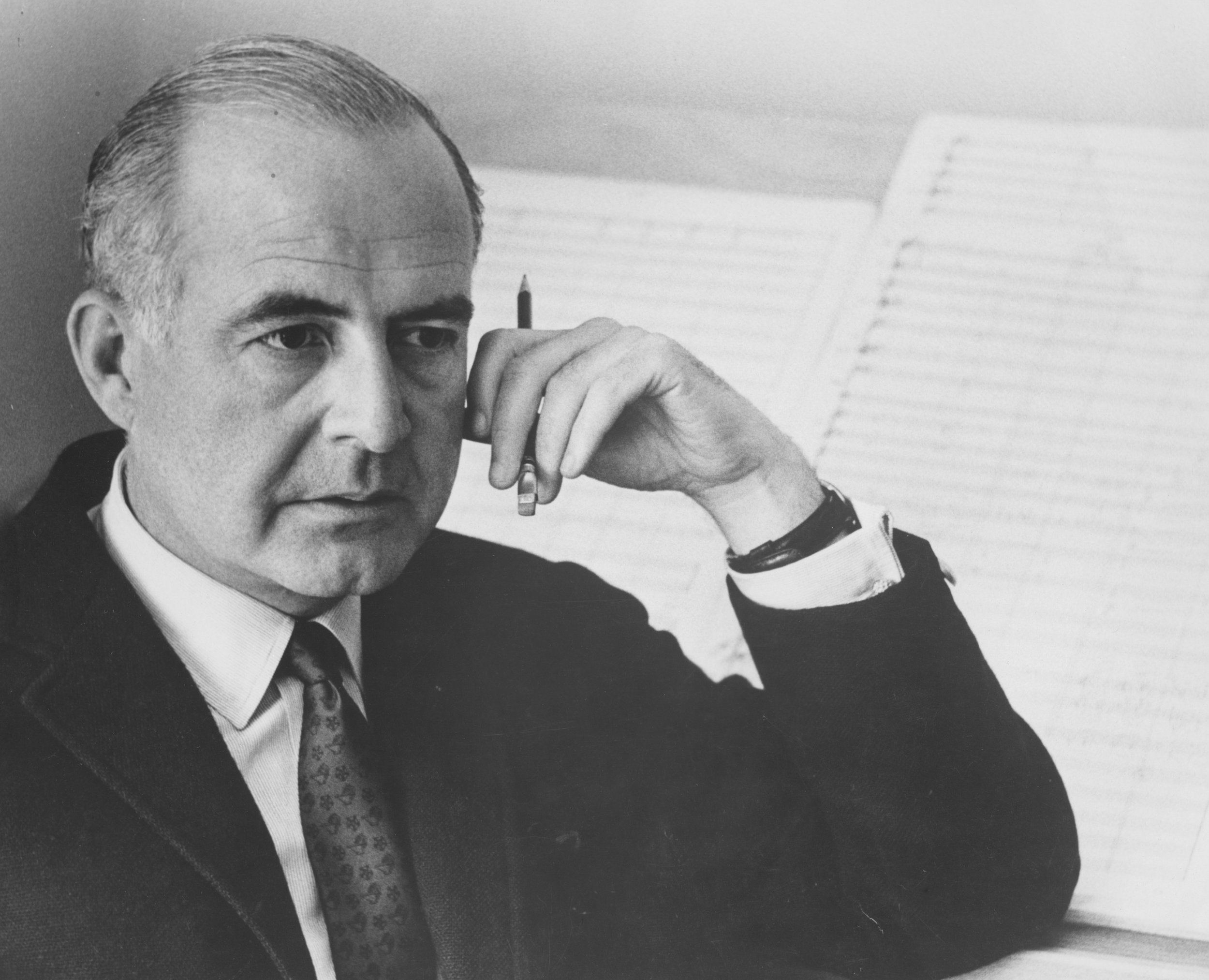
Composer: born March 9, 1910, West Chester, PA; died January 23, 1981, New York City
Work composed: 1939, rev. 1948
World premiere: Eugene Ormandy led the Philadelphia Orchestra, with violinist Albert Spalding, on February 7, 1941. The revised version was first performed by violinist Ruth Posselt, with Serge Koussevitzky leading the Boston Symphony Orchestra, on January 6, 1949.
Instrumentation: solo violin, 2 flutes (one doubling piccolo), 2 oboes, 2 clarinets, 2 bassoons, 2 horns, 2 trumpets, timpani, snare drum, piano, and strings
Estimated duration: 25 minutes
Samuel Barber wrote the Violin Concerto, his first major commission, for Samuel Fels, the inventor of Fels Naptha soap, on behalf Fels’ adopted son, violinist Iso Briselli. Barber began work on the concerto in Switzerland in the summer of 1939, but, due to what he described in a letter as “increasing war anxiety,” Barber left Europe in August and returned home with the final movement still unfinished.
At the end of summer 1939, Barber sent the first two movements to Briselli for comment. Briselli was unimpressed, describing them as “too simple and not brilliant enough for a concerto.” Taking these comments to heart, Barber resolved to write a final movement that would afford “ample opportunity to display the artist’s technical powers.” Briselli found fault with this movement as well, calling it “too lightweight” in comparison with the other movements. In a letter to Fels, Barber wrote, “[I am] sorry not to have given Iso what he had hoped for, but I could not destroy a movement in which I have complete confidence, out of artistic sincerity to myself. So we decided to abandon the project, with no hard feelings on either side.” Barber later approached violinist Albert Spalding, who immediately agreed to premiere the work. Because of all the controversy generated by the third movement, Barber gave the concerto a humorous nickname, the “concerto del sapone,” or a “soap concerto,” a reference both to Fels Naptha and the melodrama of soap operas.
Reviews praised the concerto as “an exceptional popular success” and Barber for writing a concerto “refreshingly free from arbitrary tricks and musical mannerisms … straightforwardness and sincerity are among its most engaging qualities.” The late annotator Michael Steinberg called the opening of the first movement “magical,” and goes on to ask, “Does any other violin concerto begin with such immediacy and with so sweet and elegant a melody?” Few works, certainly few concertos, draw the listener in so quickly, and keep our attention focused so completely. The Andante semplice features a heartbreakingly beautiful oboe solo – classic Barber in its yearning – and the violinist answers it with an impassioned yet surprisingly intimate melody that suggests the violin musing aloud to itself.
The finale, a rondo theme and variations, is particularly impressive. In his program notes for the 1941 premiere, Barber wrote, with characteristic understatement, “The last movement, a perpetual motion, exploits the more brilliant and virtuoso characteristics of the violin.” But as biographer Barbara Heyman points out, “This is one of the few virtually nonstop concerto movements in the violin literature (the solo instrument plays for 110 measures without interruption).”
Watch to learn more about Barber’s Violin Concert from violinist Simone Porter!
JOhannes Brahms
Symphony No. 2 in D major, op. 73
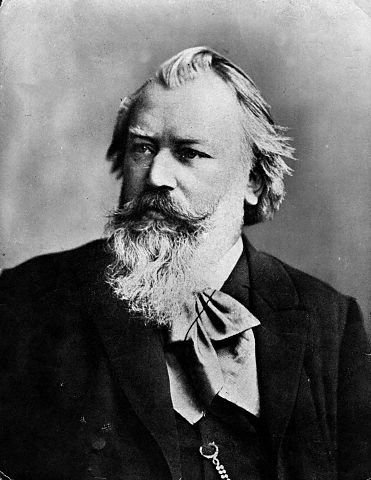
Composer: born May 7, 1833, Hamburg; died April 3, 1897, Vienna
Work composed: During the summer and fall of 1877
World premiere: Hans Richter led the Vienna Philharmonic on December 30, 1877
Instrumentation: 2 flutes, 2 oboes, 2 clarinets, 2 bassoons, 4 horns, 2 trumpets, 3 trombones, tuba, timpani, and strings.
Estimated duration:39 minutes
Less than a year after the successful premiere of Johannes Brahms’ first symphony, on November 4, 1876, the composer left Vienna to spend the summer at the lakeside town of Pörtschach on Lake Wörth, in southern Austria. There, in the beauty and quiet of the countryside, Brahms completed his second symphony. Pörtschach was to be a productive place for Brahms; over the course of three summers there he wrote several important works, including his Violin Concerto. In a letter to critic Eduard Hanslick, a lifelong Brahms supporter, Brahms wrote, “The melodies fly so thick here that you have to be careful not to step on one.”
Unlike Brahms’ first symphony, which took more than 20 years to complete, work on the second went smoothly, and Brahms finished it in just four months. Brahms felt so good about his progress that he joked with his publisher, “The new symphony is so melancholy that you won’t stand it. I have never written anything so sad … the score must appear with a black border.” In a different letter, Brahms self-mockingly observed, “Whether I have a pretty symphony I don’t know; I must ask clever people sometime.”
As Brahms composed, he shared his work-in-progress with lifelong friend Clara Schumann. “Johannes came this evening and played me the first movement of his Second Symphony in D major, which greatly delighted me,” Schumann noted in her diary in October 1877. “I find it in invention more significant than the first movement of the First Symphony … I also heard a part of the last movement and am quite overjoyed with it. With this symphony he will have a more telling success with the public as well than he did with the First, much as musicians are captivated by the latter through its inspiration and wonderful working-out.”
The Symphony No. 2 is often described as the cheerful alter ego to the solemn melancholy of the Symphony No. 1. Brahms uses the lilting notes of the Allegro non troppo as a common link throughout all four movements, where they are repeated, reversed and otherwise, in Schumann’s words, “wonderfully worked-out.” In the extended coda, Brahms introduces the trombones and tuba, casting a tiny shadow over the sunny mood. The Adagio’s lyrical cello melody hints at the wistful melancholy that characterizes so much of Brahms’ music. The Allegretto grazioso is remarkably gentle, and the infectious joy of the closing Allegro con spirito expands on the first movement’s amiable mood, so much so that at the Vienna premiere, the audience demanded an encore.
© Elizabeth Schwartz
NOTE: These program notes are published here by the Modesto Symphony Orchestra for its patrons and other interested readers. Any other use is forbidden without specific permission from the author, who may be contacted at www.classicalmusicprogramnotes.com

Holiday Candlelight Concert
Tuesday, December 20, 2022 at 8 pm
Modesto Symphony Orchestra
Holiday Candlelight Concert
Tuesday, December 20, 2022
Doors Open at 7 pm
Concert Starts at 8 pm
St. Stanislaus Catholic Church
1200 Maze Boulevard, Modesto
Program
Johann Sebastian Bach
Orchestral Suite No. 1 in C Major, BWV 1066
I. Overture
VI. Bourrée I and II
George Frideric Handel arr. Tom Kennedy
Joy to the World
- Audience Hum-Along -
arr. Joel Raney and Arnold Sherman
An Angelic Celebration
- Opus Handbell Ensemble -
H. Dean Wagner
Carillon
- Opus Handbell Ensemble -
arr. Deborah Kavasch
O Come, O Come Emmanuel
John Rutter
The Very Best Time of the Year
George Frideric Handel
Water Music
V. Air
Ottorino Respighi
Ancient Airs and Dances, Suite No. 1
III. Villanella
Lewis Redner arr. Tom Kennedy
O Little Town of Bethlehem
- Audience Hum-Along -
arr. Steven Pilkington
Coventry Carol
arr. Anna Laura Page
Mary, Did You Know?
- Opus Handbell Ensemble -
arr. Nicholas Hanson
Fum, Fum, Fum
- Opus Handbell Ensemble -
arr. Tom Kennedy
Silent Night
- Audience Hum-Along -
Libby Larsen
Beautiful Star
arr. Mark Riese
I Saw Three Ships
Join Mobile MSO!
Text “CANDLELIGHT” to (209) 780-0424
to receive a link to the concert program & text message updates prior to this performance!
By texting to this number, you may receive messages that pertain to the Modesto Symphony Orchestra and its performances. msg&data rates may apply. Reply HELP for help, STOP to cancel.
About this Performance

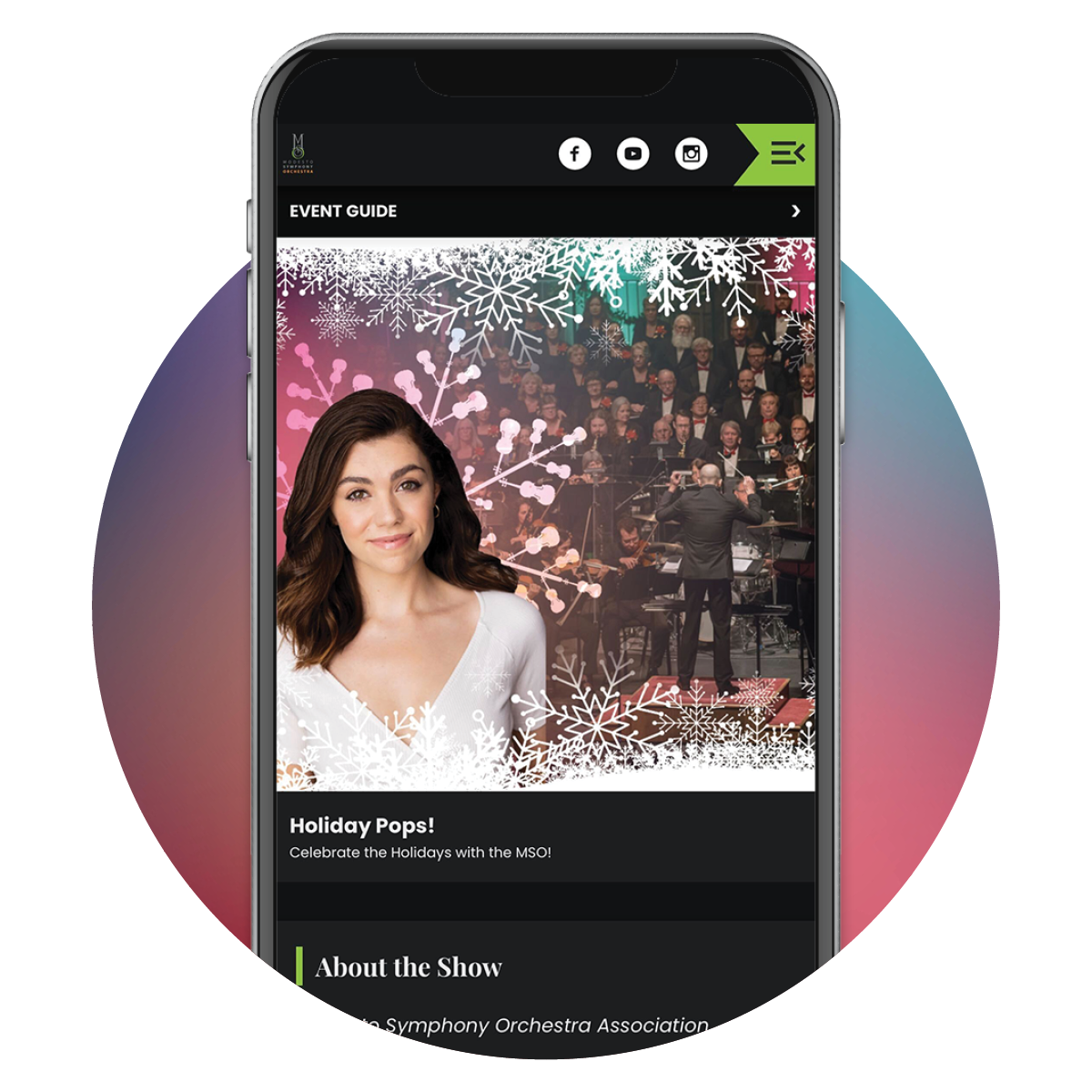
Holiday Pops!
December 2, 2022 at 7:30 pm
December 3, 2022 at 2 pm
VISIT MOBILE PROGRAM →
DOWNLOAD PRINTABLE VERSION →
Modesto Symphony Orchestra
Holiday Pops!
Friday, December 2, 2022 at 7:30 pm
Saturday, December 3, 2022 at 2 pm
Mary Stuart Rogers Theater, Gallo Center for the Arts

Program
Holiday Overture
Elliot Carter / arr. James M. Stephenson, III
Ring the Bells!
Rosephanye Powell
Hark! the Herald Angels Sing
Felix Mendelssohn / arr. Dan Forrest
It’s The Most Wonderful Time of the Year
Edward Pola & George Wyle / arr. Jim Kessler
We Need A Little Christmas
Jerry Herman / arr. by Jim Kessler
Think of Me
Andrew Lloyd Webber & Charles Hart
A Charleston Christmas
arr. James M. Stephenson, III
Christmas Eve/Sarajevo 12/24
Paul O’Neill & Robert Kinkel / arr. by Bob Phillips
All I Want for Christmas is You
Mariah Carey & Walter Afanasieff / arr. Luke Flynn
Intermission -
A Christmas Festival
Leroy Anderson
O Come, O Come, Emmanuel
arr. Taylor Scott Davis
Sleigh Ride
by Leroy Anderson
I Saw Three Ships
arr. James M. Stephenson, III
“Christmas Time is Here” from A Charlie Brown Christmas
Vince Guaraldi / arr. Jim Gray
Jingle Bell Rock
Joseph Beal & James Boothe / arr. Jim M. Stephenson, III
I’ve Got My Love to Keep Me Warm
Irving Berlin / arr. Jim Gray
O Holy Night!
Adolphe Adam / arr. & orc. David T. Clydesdale
Join Mobile MSO!
Text “HOLIDAY” to (209) 780-0424
to receive a link to the concert program & text message updates prior to this weekend’s performance!
By texting to this number, you may receive messages that pertain to the Modesto Symphony Orchestra and its performances. msg&data rates may apply. Reply HELP for help, STOP to cancel.
About this Performance


MSYO Season Opening Concert
November 12, 2022 at 2 pm
Modesto Symphony Youth Orchestra
Season Opening Concert
Saturday, November 12, 2022 at 2 pm
Gallo Center for the Arts, Mary Stuart Rogers Theater

Concert Orchestra
Donald C. Grishaw, conductor
Jean Sibelius (1865-1957), arr. Meyer
Finlandia
Arr. Merle Issac (1898-1996)
Two South American Tango
I. El Choclo
II. La Compasita
Nicolai Rimski-Korsakov (1844-1908) arr. Issac
Fandango and Alborada
Intermission
Symphony Orchestra
Wayland Whitney, conductor
Ralph Vaughn Williams (1872-1958)
March Past of the Kitchen Utensils
Edward German (1862-1936)
Three Dances from Henry VII
I. Morris Dance
II.Torch Dance
Joseph Franz Haydn (1732-1809)
Symphony No. 104, “London”
I. Adagio - Allegro
IV. Finale
Join Mobile MSO!
Text “MSYO” to (209) 780-0424
to receive a link to the concert program & text message updates prior to this performance!
By texting to this number, you may receive messages that pertain to the Modesto Symphony Orchestra and its performances. msg&data rates may apply. Reply HELP for help, STOP to cancel.
About this Performance
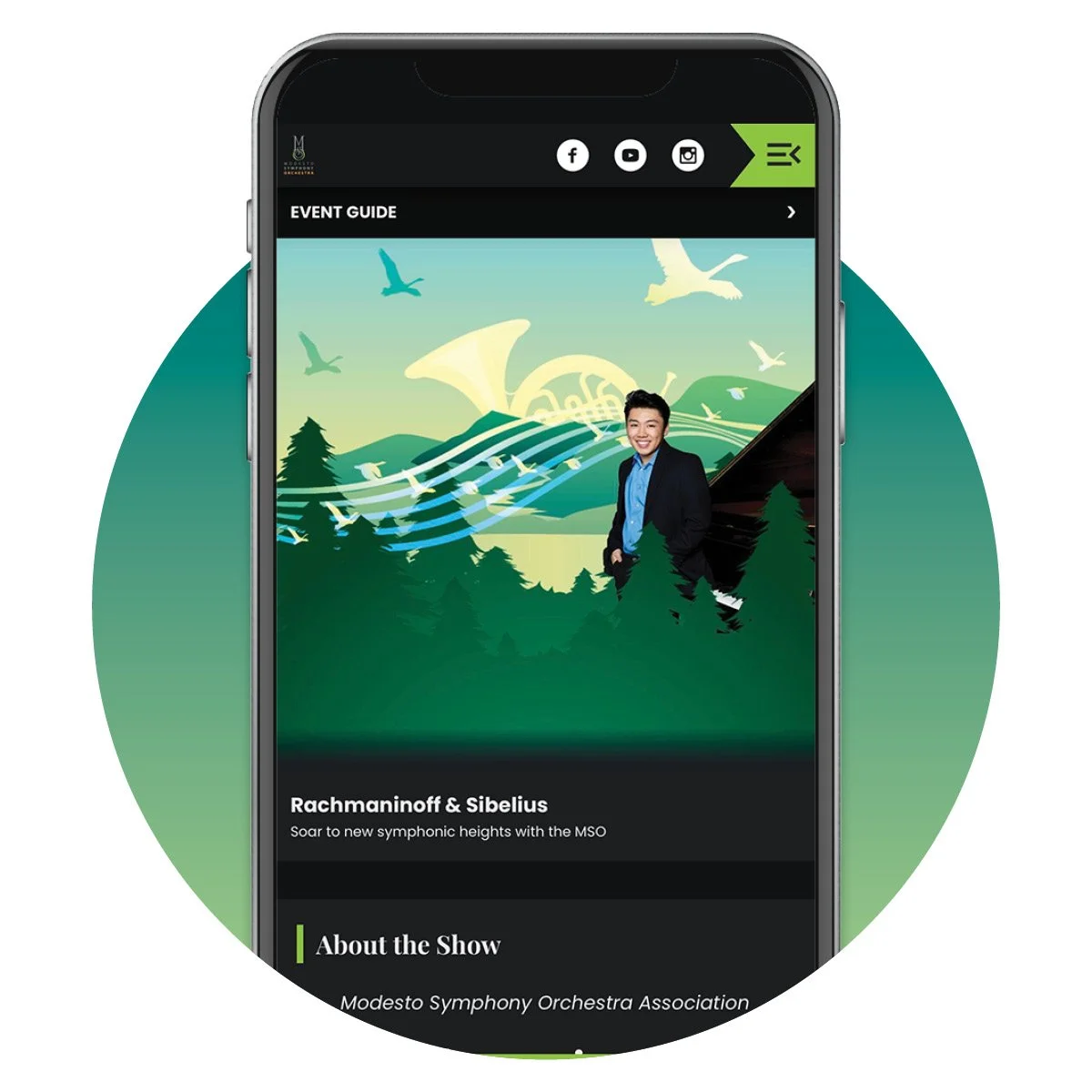
Rachmaninoff & Sibelius
November 11 & 12, 2022 at 7:30 pm
VISIT MOBILE PROGRAM →
READ OUR PROGRAM NOTES →
DOWNLOAD PRINTABLE VERSION (pdf, 3mb) →
Modesto Symphony Orchestra
Rachmaninoff & Sibelius
Friday, November 11, 2022 at 7:30 pm
Saturday, November 12, 2022 at 7:30 pm
Gallo Center for the Arts, Mary Stuart Rogers Theater
Nicholas Hersh, conductor
George Li, piano

Program
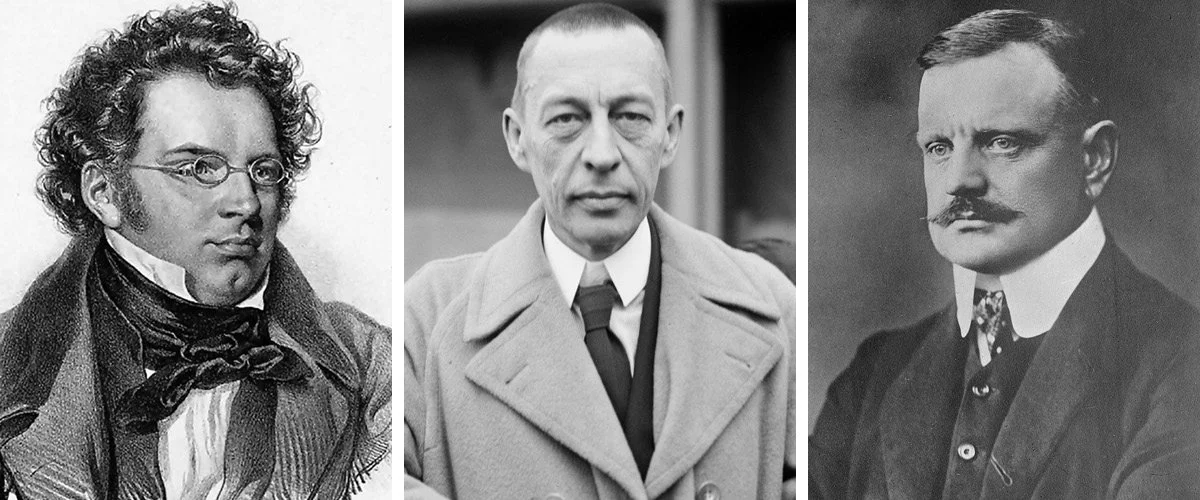
Franz Schubert (1797-1828)
arr. Nicholas Hersh
String Quartet No. 14, II. Andante con moto
Variations on a Theme "Death and the Maiden"
Sergei Rachmaninoff (1873-1943)
Rhapsody on a Theme of Paganini (1934)
George Li, piano
INTERMISSION
Jean Sibelius (1865-1957)
Symphony No. 5 in E-flat major, Op. 95 82 (1915)
i. Tempo molto moderato – Allegro moderato – Presto
ii. Andante mosso, quasi allegretto
iii. Allegro molto – Misterioso – Un pochettino largamente
Join Mobile MSO!
Text “SIBELIUS” to (209) 780-0424
to receive a link to the concert program & text message updates prior to this performance!
By texting to this number, you may receive messages that pertain to the Modesto Symphony Orchestra and its performances. msg&data rates may apply. Reply HELP for help, STOP to cancel.
About this Performance
Program Notes: Rachmaninoff & Sibelius
Notes about:
Schubert’s String Quartet No. 14
Rachmaninoff’s Rhapsody on a Theme of Paganini
Sibelius’ Symphony No. 5 in E-flat major
Program Notes for November 11 & 12, 2022
Rachmaninoff & Sibelius
Program Book
Franz Schubert (arr. Hersh)
String Quartet No. 14, II. Andante con moto
Variations on a Theme "Death and the Maiden"

Composer: born January 31, 1797, Vienna; died November 19, 1828, Vienna
Work composed: March 1824; dedicated to violinist Ignaz Schuppanzigh.
World premiere: First performed in a private gathering at the home of Josef Barth on February 1, 1826
Instrumentation: string orchestra
Estimated duration: 10 minutes
In 1824, 27-year-old Franz Schubert was physically and mentally worn out from his years-long battle with syphilis, a battle he lost four years later. The disease caused him extreme pain and weakness, and amplified his tendency to depression. On March 31, 1824, Schubert wrote to a friend, “I feel myself to be the most unfortunate, the most miserable being in the world. Think of a man whose health will never be right again, and who from despair over the fact makes it worse instead of better … My peace is gone, my heart is heavy … each night when I go to sleep I hope never again to wake, and each morning merely reminds me of the misery of yesterday.”
The String Quartet in D minor reflects Schubert’s understandable preoccupation with mortality, from its powerful opening notes through the meditative, soothing Andante; from the angry denunciations of the Scherzo to the breathless defiance of the Presto. The nickname “Death and the Maiden” comes from Schubert’s 1817 setting of Matthias Claudius’ eponymous poem, written in the form of a dialogue between Death and a young woman. The maiden pleads for her life, while Death woos her with promises of an eternal, all-embracing sleep. Schubert repurposed Death’s melody from the song as the basis for the second movement’s theme and variations.
Notes from the Arranger, Nicholas Hersh
This set of variations on the lied "Der Tod und das Mädchen" is an orchestration of the complete second movement of the String Quartet No. 14 "Death and the Maiden," functioning in this arrangement as a standalone concert piece for chamber orchestra. The string section presents the unaltered theme, while the five subsequent variations and coda explore various orchestral colors. I have attempted to preserve Schubert's original markings wherever possible, but I also took an occasional liberty to better serve this symphonic milieu.

Sergei Rachmaninoff
Rhapsody on A Theme of Paganini, Op. 43

Composer: born April 1, 1873, Semyonovo, Starorusky District, Russia; died March 28, 1943, Beverly Hills, CA
Work composed: Rachmaninoff wrote his Rhapsody in six weeks, from July 3 – August 18, 1934, while staying at his villa in Switzerland.
World premiere: Leopold Stokowski led the Philadelphia Orchestra with Rachmaninoff as soloist at the Lyric Opera house in Baltimore, Maryland, on November 7, 1934
Instrumentation: solo piano, piccolo, 2 flutes, 2 oboes, English horn, 2 clarinets, 2 bassoons, 4 horns, 2 trumpets, 3 trombones, tuba, timpani, bass drum, cymbals, glockenspiel, snare drum, triangle, harp, and strings.
Estimated duration: 23 minutes
After he left Russia, Sergei Rachmaninoff found little time for composition. He had a family to support, and his skills as a conductor and concert pianist were more in demand, and paid far better, than composition. Consequently, Rachmaninoff wrote relatively little in the years after the Russian Revolution; instead, he toured with earlier works, like the Second and Third Piano Concertos.
The Rhapsody on a Theme of Paganini is an exception; Rachmaninoff wrote it in 1934, just seven years before his death. Based on the last of Niccolò Paganini’s 24 Caprices for Solo Violin, this melody has inspired variations from a number of other composers, including Franz Liszt, Johannes Brahms, and Witold Lutosławski.
Audiences immediately responded to the Rhapsody’s technical virtuosity and unabashed romanticism. As the late musicologist Michael Steinberg noted, “[the Rhapsody] embodies [Rachmaninoff’s] late style at its brilliant and witty best, it has one of the world’s irresistible melodies and it gives the audiences the satisfaction of watching a pianist work very hard and with obviously rewarding results.”
Critics were far less enthusiastic: one described it as “trite to the verge of cheapness,” while another opined, “[it is] just a concert piece for the composer’s playing, and the day for that sort of thing is past.” The New Yorker critic was especially harsh, denigrating both music and audience: “The Rhapsody isn’t philosophical, significant, or even artistic. It is something for audiences.” Despite the condescending reviews, the Rhapsody became an instant hit on the concert circuit, and remains one of the most popular works for piano and orchestra.
The Rhapsody can be organized into the conventional outline of a piano concerto, with the first ten variations (some under 20 seconds) corresponding to a first movement. These ten variations stay very close to Paganini’s theme and remain in the key of A minor, each one building on the excitement and tension of its predecessor. Variation 11 transitions to the slow “second movement” (variations 12-18). In keeping with the middle movement of a concerto, the harmony shifts from A minor and wanders through several other keys until it arrives at the famous 18th variation in D-flat major, which was featured in the 1993 hit movie Groundhog Day. “This one,” Rachmaninoff shrewdly commented, “is for my agent.” While this variation seems unrelated to the fundamental melody, Rachmaninoff constructed it by simply inverting Paganini’s original theme. The final six variations make up the third movement and feature Paganini’s opening theme as the Rhapsody builds to its fiery climax.
Jean Sibelius
Symphony No. 5 in E-flat major, Op. 82

Composer: born December 8, 1865, Hämeenlinna, Finland; died September 20, 1957, Järvenpää, Finland
Work composed: 1914-15, rev. 1916, 1919
World premiere: Sibelius completed the first version of the Fifth Symphony just in time to conduct it for his fiftieth birthday on December 8, 1915, with the Helsinki Municipal Orchestra. A year later, Sibelius revised Op. 82 and conducted it with the same ensemble. The final version was completed in 1919; Sibelius conducted it on October 21, 1921.
Instrumentation: 2 flutes, 2 oboes, 2 clarinets, 2 bassoons, 4 horns, 3 trumpets, 3 trombones, timpani, and strings
Estimated duration: 31 minutes
“These symphonies of mine are more confessions of faith than are my other works,” wrote Jean Sibelius in 1918, while revising his Symphony No. 5 for the third time. Always his own harshest critic, Sibelius struggled to realize his original musical conception of the Symphony over a period of six difficult years.
Sibelius’ multiple attempts to write a version of the Fifth Symphony that withstood his implacable self-criticism were hampered by personal problems and global upheaval. In the years 1910-14, Sibelius struggled with the desire to be perceived by the world as a “modern” composer, but at the same time he rejected the prevailing styles established by Debussy, Mahler, and Richard Strauss. Composing, frequently difficult for Sibelius even under the best of circumstances, was made even harder by the composer’s poor health and chronic alcoholism.
From 1914-18, the chaos and brutality of WWI engulfed Europe. In 1917 Finland declared independence from Russia, which sparked additional conflict between the two countries. In 1918, an invasion of Russian soldiers into his town forced Sibelius and his family to flee to Helsinki. Later that year, Sibelius returned home and resumed his life and work, including the third revision of the Fifth Symphony, which he described as “practically composed anew.”
The reworked symphony condenses the original four movements into three – Sibelius combined the first and second movements – and features a new finale. The Tempo molto moderato is textbook Sibelius, featuring brief, fragmentary ideas that surface somewhat enigmatically from the depths of the orchestra. A short melody in the horns later coalesces into a fully developed theme. At times the instruments seem to murmur to themselves; as the music progresses, the strings and brasses declaim bold proclamations.
In the Andante mosso, pizzicato strings and staccato flutes state the primary melody, while a group of woodwinds and horns sound a counter-theme of long sustained notes. These shimmering notes become a backdrop for several variations on the staccato main theme.
On April 21, 1915, Sibelius wrote in his diary, “Today at ten to eleven I saw 16 swans. One of my greatest experiences. Lord God, that beauty!” The opening of the finale captures this rustle of wings with tremolo strings accompanying an expansive melody, also in the strings. Sibelius juxtaposed this breathless music with a majestic “swan theme” sounded first by the horns. As the symphony concludes, the swan theme becomes an exultant shout of triumph.
© Elizabeth Schwartz
NOTE: These program notes are published here by the Modesto Symphony Orchestra for its patrons and other interested readers. Any other use is forbidden without specific permission from the author, who may be contacted at www.classicalmusicprogramnotes.com
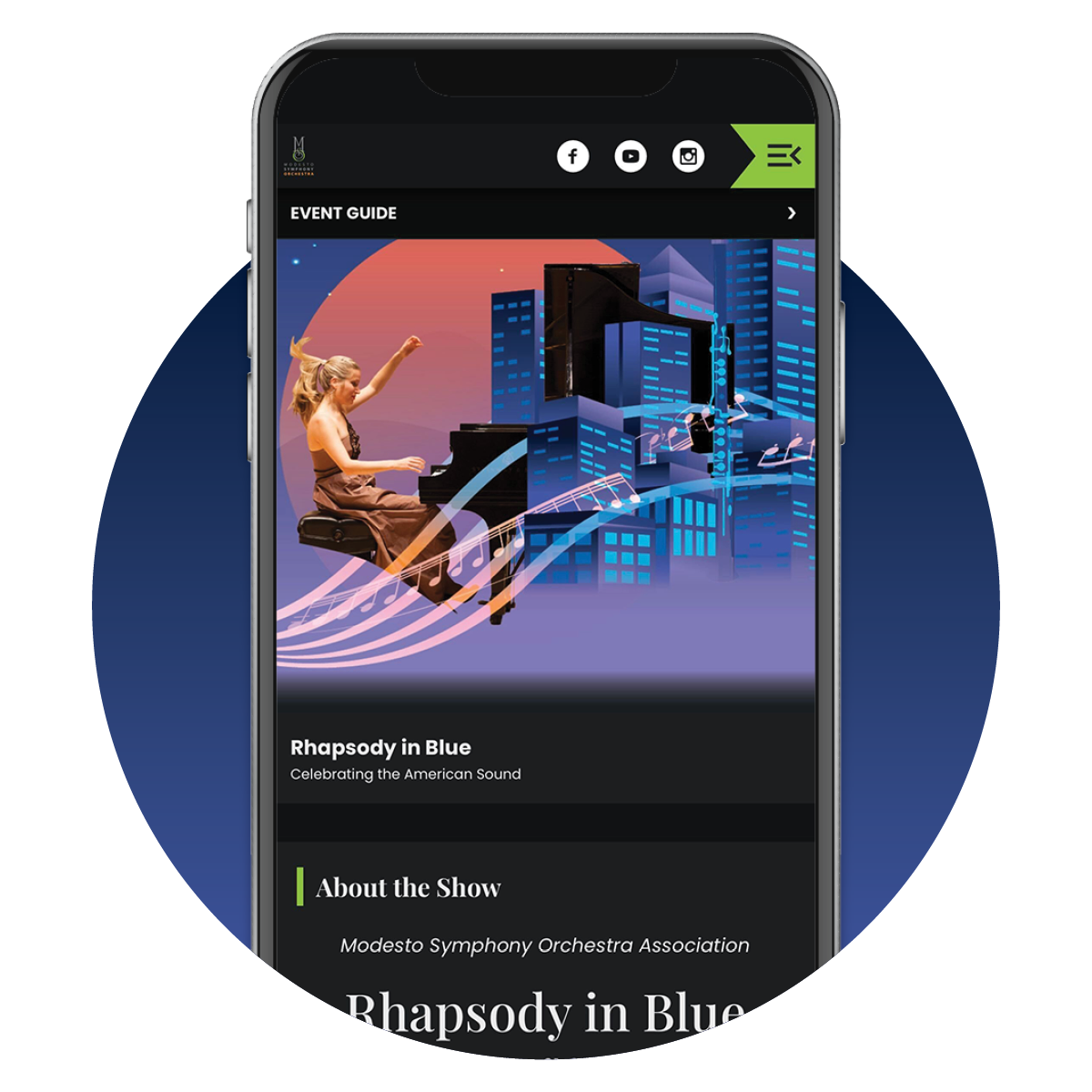
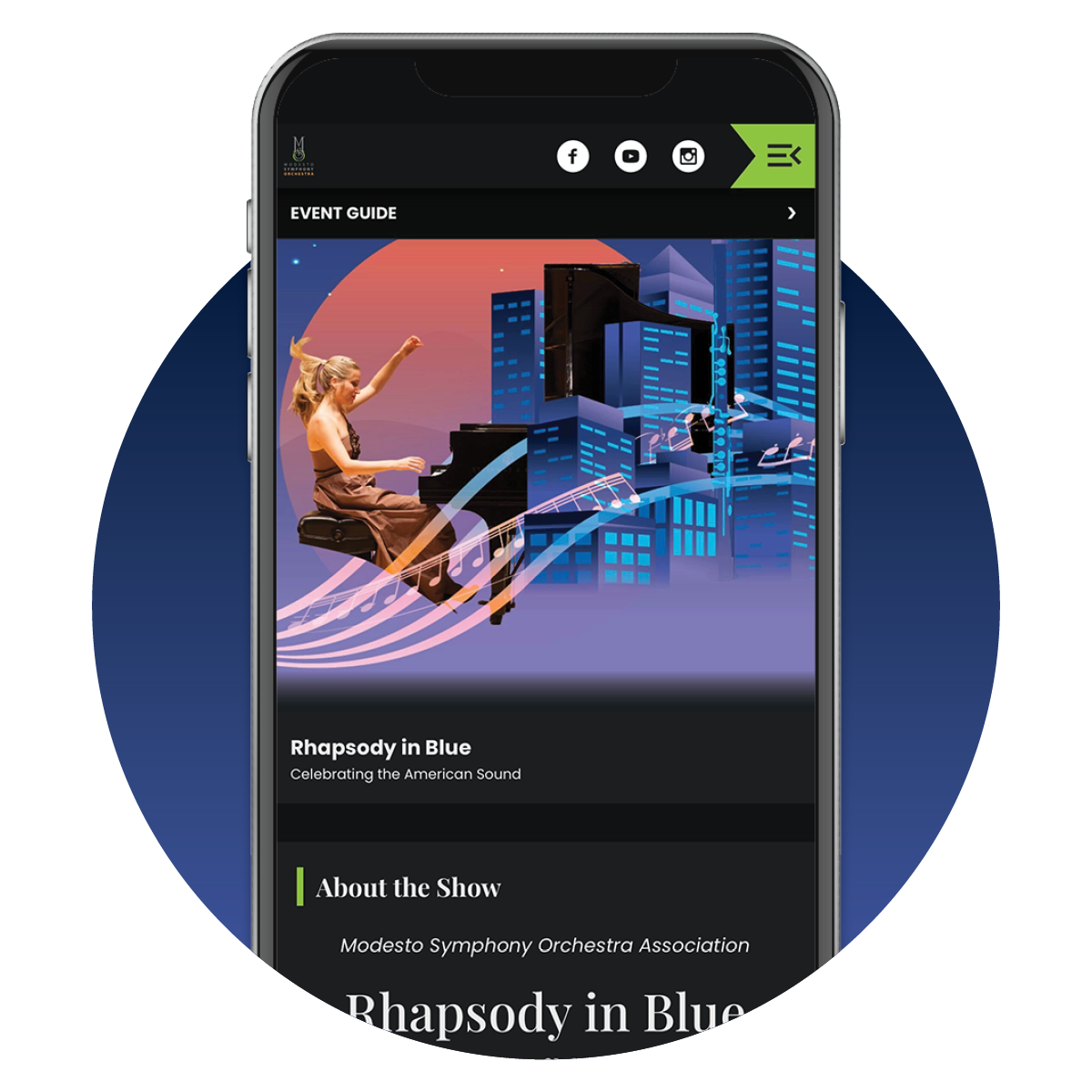
Rhapsody in Blue
October 21 & 22, 2022 at 7:30 pm
VISIT MOBILE PROGRAM →
READ OUR PROGRAM NOTES →
DOWNLOAD PRINTABLE VERSION (pdf, 3mb) →
Modesto Symphony Orchestra
Rhapsody in Blue
Friday, October 21, 2022 at 7:30 pm
Saturday, October 22, 2022 at 7:30 pm
Gallo Center for the Arts, Mary Stuart Rogers Theater
Christopher Dragon, conductor
Gabriela Martinez, piano
Program
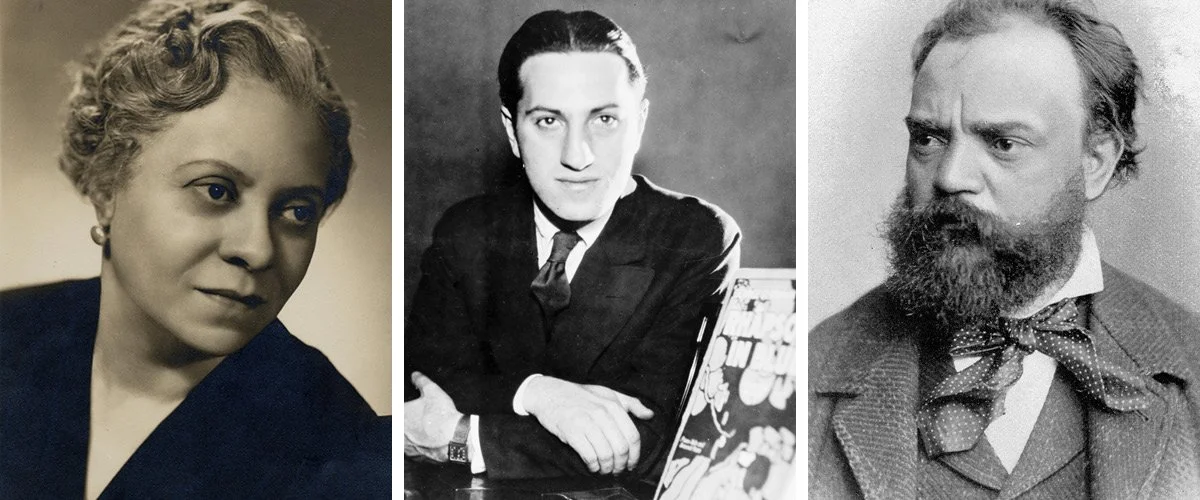
Florence Price (1887-1953)
Concert Overture No. 2 (1943)
George Gershwin (1898-1937)
Rhapsody in Blue (1924)
Gabriela Martinez, piano
INTERMISSION
Antonín Dvořák (1841-1904)
Symphony No. 9 in E minor, "From the New World," Op. 95 (1893)
I.Adagio - Allegro molto
II. Largo
III. Molto vivace
IV. Allegro con Fuoco
Join Mobile MSO!
Text “BLUE” to (209) 780-0424
to receive a link to the concert program & text message updates prior to this performance!
By texting to this number, you may receive messages that pertain to the Modesto Symphony Orchestra and its performances. msg&data rates may apply. Reply HELP for help, STOP to cancel.
About this Performance

Program Notes: Rhapsody in Blue
Notes about:
Price’s Concert Overture No. 2
Gershwin’s Rhapsody in Blue
Dvořák’s Symphony No. 9 in E minor, “From the New World,” Op. 95
Program Notes for October 21 & 22, 2022
Rhapsody in Blue

Florence Price
Concert Overture No. 2
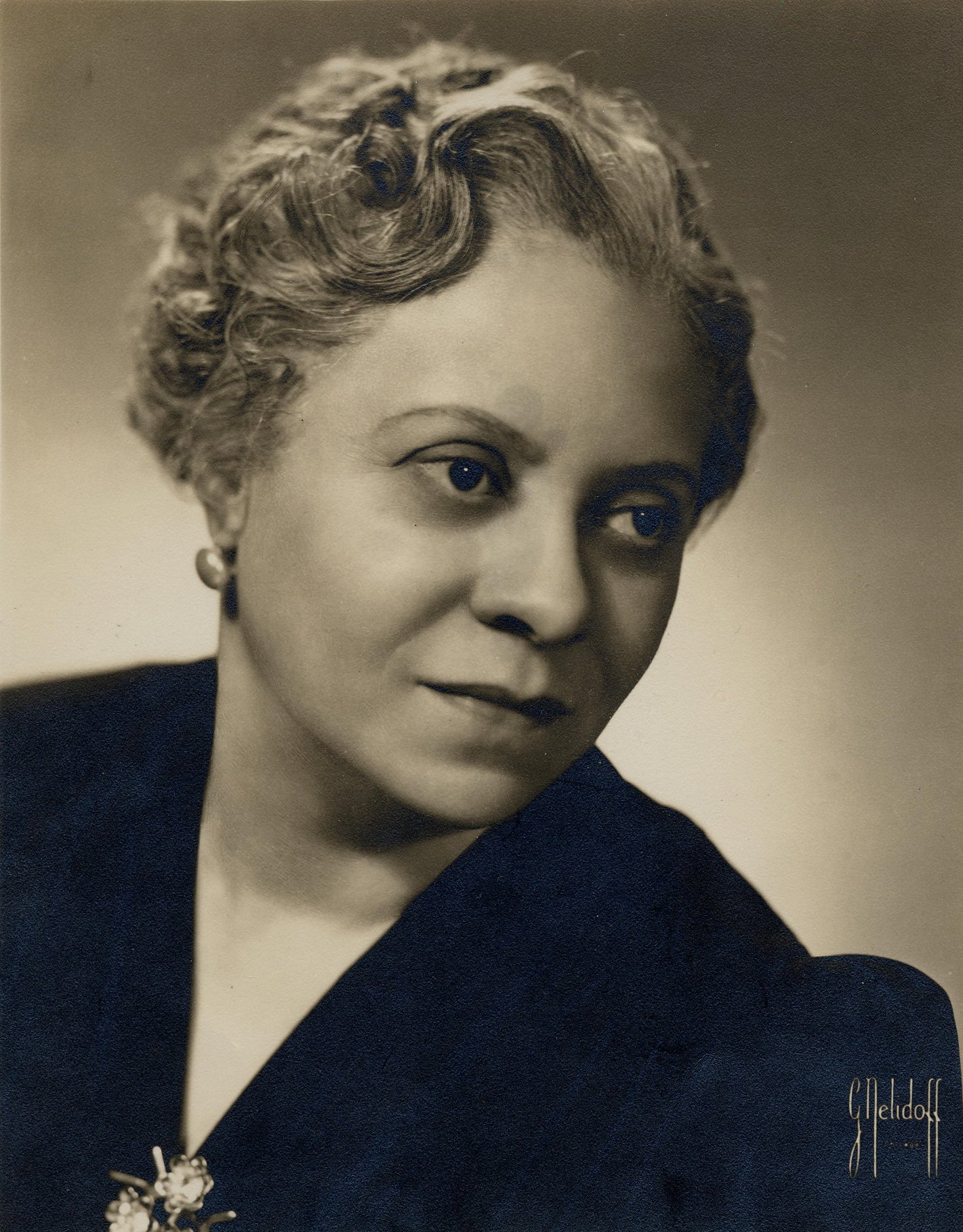
Composer: born April 9, 1887, Little Rock, AR; died June 3, 1953, Chicago
Work composed: 1943
World premiere: undocumented
Instrumentation: piccolo, 3 flutes, 2 oboes, English horn, 2 clarinets, bass clarinet, 2 bassoons, 4 horns, 3 trumpets, 3 trombones, tuba, timpani, bass drum, cymbals, snare drum, harp, and strings
Estimated duration:15 minutes
As the first Black female American composer to have a symphony performed by a major orchestra, Florence Price enjoyed considerable renown during her lifetime. Her compositional skill and fame notwithstanding, the entrenched institutional racism and sexism of the white male classical music establishment effectively erased Price and her music from general awareness for decades after her death. In 2009, a large collection of scores and unpublished works by Price were discovered in a house in rural Illinois. Since then, scholars, musicians, and audiences have been discovering Price’s work and her rich legacy.
The daughter of a musical mother, Price was a prodigy, giving her first recital at age four and publishing her first composition at 11. During her childhood and teens, Price’s mother was the guiding force behind her piano and composition studies. Young Florence entered New England Conservatory in 1903, at 16, where she double majored in organ performance and piano pedagogy. While at NEC, Price also studied composition with George Whitefield Chadwick. Chadwick was an early champion of women as composers, which was highly unusual at the time, and he believed that American composers should incorporate the rich traditions of native American and “Negro” styles in their own works. Price, already inclined in this direction, was encouraged by Chadwick, and many of her works, including tonight’s Concert Overture No. 2, reflect the expressive and distinctive sounds of Negro traditions, particularly the spirituals, ragtime, and folkdance rhythms whose origins trace back to Africa. This overture features the spirituals “Go Down, Moses,” “Nobody Knows the Trouble I’ve Seen,” and “Every Time I Feel the Spirit.”
George Gershwin
Concerto for Tabla & Orchestra
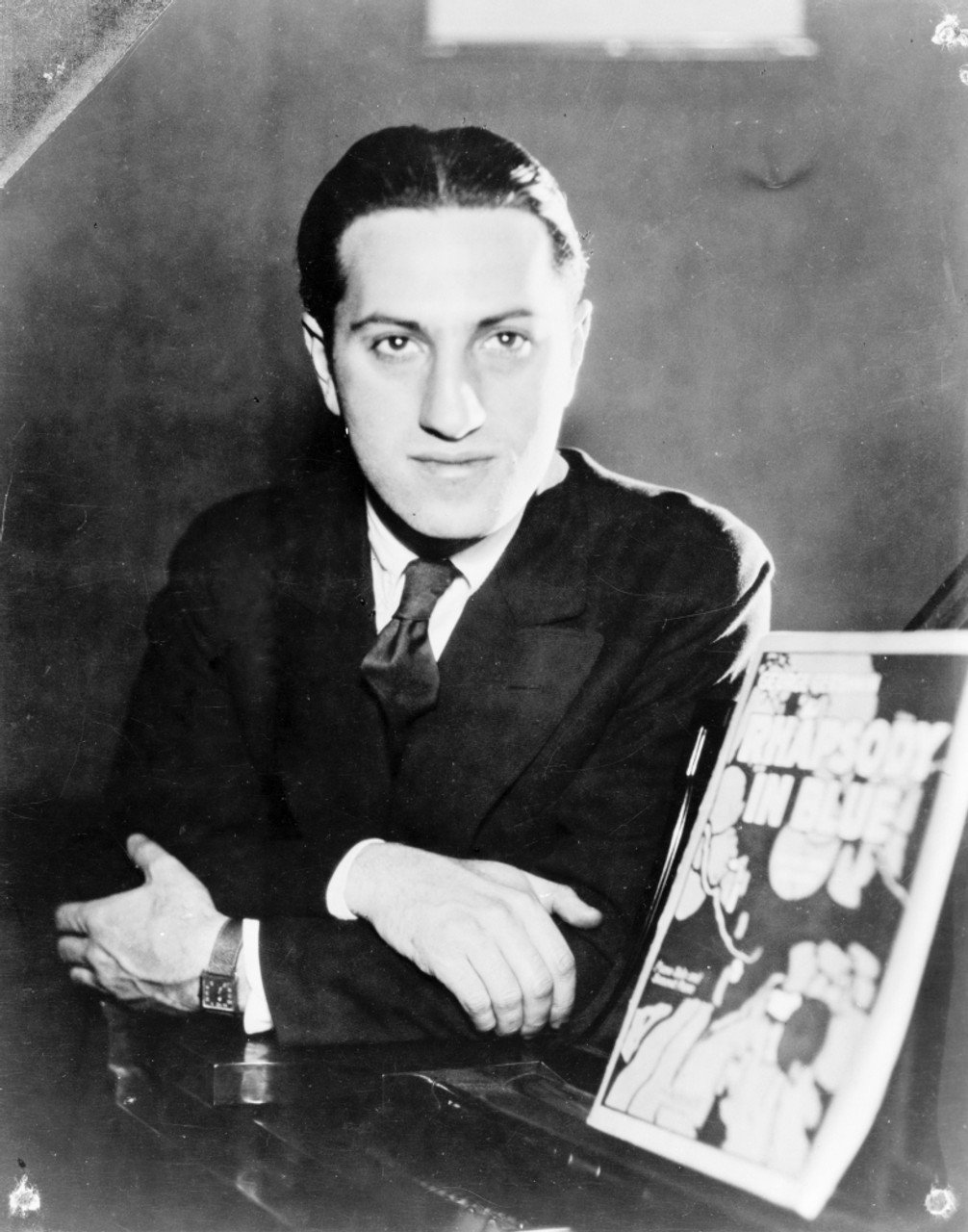
Composer: born September 26, 1898, Brooklyn, NY; died July 11, 1937, Hollywood, CA
Work composed: Gershwin wrote Rhapsody in Blue in the first three weeks of 1924
World premiere: Gershwin was at the piano when Paul Whiteman’s Orchestra premiered Rhapsody in Blue at Aeolian Hall in New York City, on February 12, 1924
Instrumentation: solo piano, 2 flutes, 2 oboes, 2 clarinets, bass clarinet, alto saxophone, tenor saxophone, 3 horns, 3 trumpets, 3 trombones, tuba, timpani, bass drum, cymbals, gong, glockenspiel, snare drum, celesta, triangle, banjo, and strings
Estimated duration: 15 minutes
Rhapsody in Blue introduced jazz to classical audiences, and simultaneously made an instant star of its composer. From its iconic clarinet glissando to its brilliant finale, Rhapsody in Blue epitomizes the Gershwin sound, and transformed the 25-year-old Tin Pan Alley songwriter into a composer of “serious” music.
On January 4, 1924, Ira Gershwin showed George a news report in the New York Tribune about a concert put together by jazz bandleader Paul Whiteman, grandiosely titled “An Experiment in Modern Music,” that would endeavor to trace the history of jazz. The article concluded, “George Gershwin is at work on a jazz concerto.” This was certainly news to Gershwin, who was then in rehearsals for a Broadway show, Sweet Little Devil. Gershwin contacted Whiteman to refute the Tribune article, but Whiteman eventually talked Gershwin into writing the concerto.
In 1931, Gershwin described to biographer Isaac Goldberg how the musical ideas for Rhapsody in Blue first emerged: “It was on the train, with its steely rhythms, its rattle-ty bang, that is so often so stimulating to a composer … And there I suddenly heard, and even saw on paper – the complete construction of the Rhapsody, from beginning to end … I heard it as a sort of musical kaleidoscope of America, of our vast melting pot, of our unduplicated national pep, of our metropolitan madness. By the time I reached Boston I had a definite plot of the piece, as distinguished from its actual substance.”
At the premiere, Gershwin’s unique realization of this “musical kaleidoscope of America,” coupled with his phenomenal abilities at the keyboard, wowed the audience as much as the novelty of hearing jazz idioms in a classical work.
The opening clarinet solo got its signature jazzy glissando from Whiteman’s clarinetist Ross Gorman. This opening unleashes a floodgate of colorful ideas that blend seamlessly. The pulsing syncopated rhythms and showy music eventually morph into a warm, expansive melody à la Sergei Rachmaninoff.
Antonín Dvořák
Symphony No. 9 in E minor, Op. 95, “From the New World”
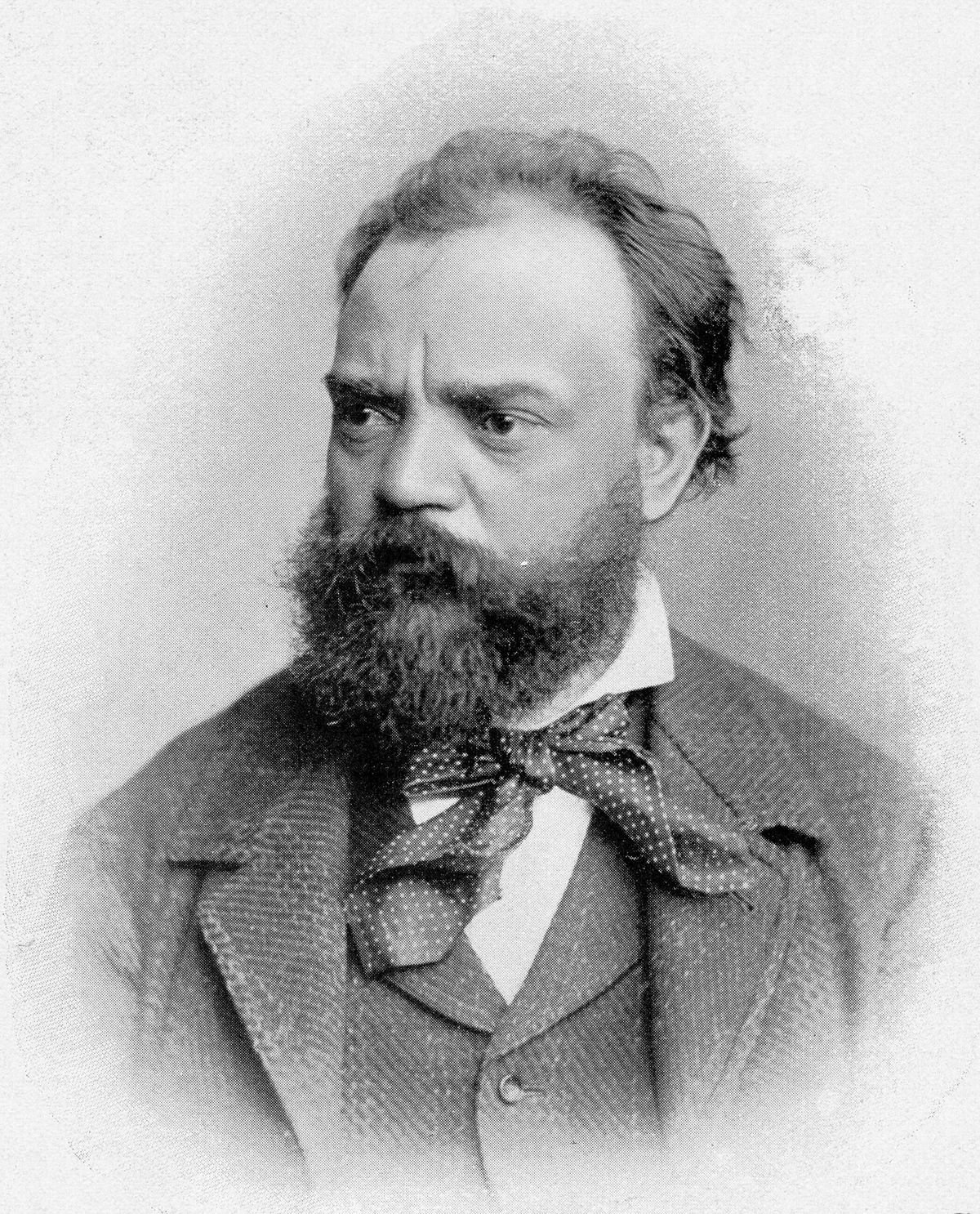
Composer: born September 8, 1841, Nelahozeves, near Kralupy in Bohemia (now the Czech Republic); died May 1, 1904, Prague
Work composed: 1892-1893 in New York City
World premiere: Anton Seidl led the New York Philharmonic on December 16, 1893, at Carnegie Hall.
Instrumentation: 2 flutes (1 doubling piccolo), 2 oboes, English horn, 2 clarinets, 2 bassoons, 4 horns, 2 trumpets, 3 trombones, tuba, timpani, cymbals, triangle, and strings.
Estimated duration: 40 minutes
Antonín Dvořák began his Ninth Symphony in December 1892, shortly after he arrived in America, and completed it the following May. During his three-year sojourn in New York, Dvořák explored the city, watched trains and large ships arrive and depart, fed pigeons in Central Park, and met all kinds of people. Late in 1892, Dvořák wrote to a friend back home, “The Americans expect great things of me. I am to show them the way into the Promised Land, the realm of a new, independent art, in short, a national style of music! … This will certainly be a great and lofty task, and I hope that with God’s help I shall succeed in it. I have plenty of encouragement to do so.”
Dvořák was also introduced to a great deal of American folk music, including Native American melodies and Negro spirituals. However, he did not quote any of them in the Ninth Symphony. Dvořák explained, “The influence of America can be readily felt by anyone with ‘a nose.’” That is, hints of the uniquely American flavor of this music are discernable throughout, as Dvořák made use of the syncopated rhythms, repeated patterns, and particular scales common to much of America’s indigenous music. But the Ninth Symphony is not a patchwork of previously existing materials, and all the melodies in the Ninth Symphony are Dvořák’s own (including the famous English horn solo in the Largo, which was later given the title “Goin’ Home,” with accompanying text, by one of Dvořák’s New York composition students, a young Black composer and baritone named Harry Burleigh).
“I have simply written original themes embodying the peculiarities of Indian music, and, using these themes as subjects, have developed them with all the resources of modern rhythms, harmony, counterpoint, and orchestral color,” Dvořák explained. As for the title, “From the New World,” Dvořák intended it as an aural picture postcard to be mailed back to friends and family in Europe and meant simply “Impressions and Greetings from the New World.”
At the premiere, the audience applauded every movement with great enthusiasm, especially the Largo, which they cheered without pause until Dvořák rose from his seat and took a bow. A critic writing for the New York Evening Post spoke for most when he wrote, “Anyone who heard it could not deny that it is the greatest symphonic work ever composed in this country … A masterwork has been added to the symphonic literature.”
© Elizabeth Schwartz
NOTE: These program notes are published here by the Modesto Symphony Orchestra for its patrons and other interested readers. Any other use is forbidden without specific permission from the author, who may be contacted at www.classicalmusicprogramnotes.com
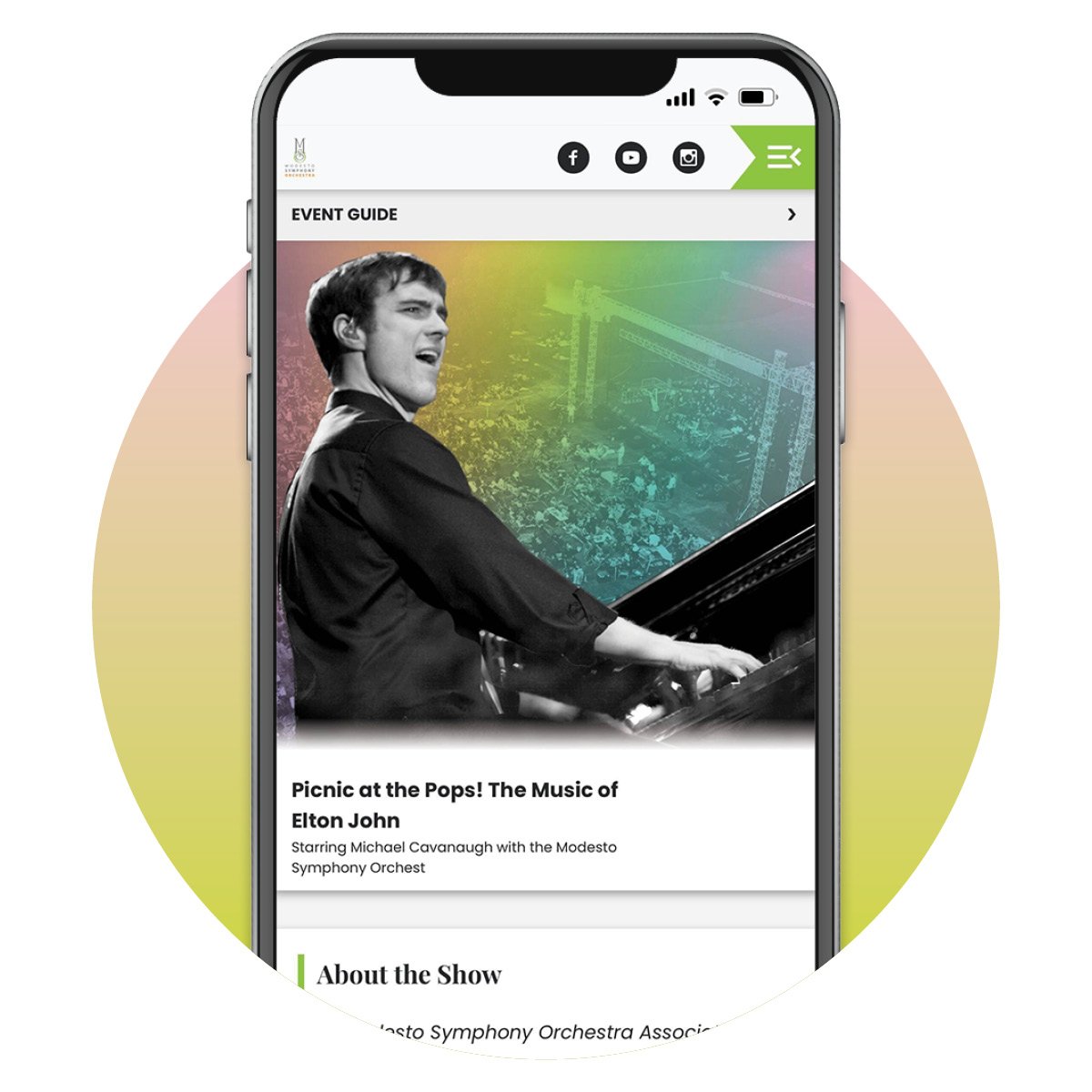
Picnic at the Pops! The Music of Elton John
September 10, 2022
Modesto Symphony Orchestra
Picnic at the Pops! The Music of Elton John
Starring Michael Cavanaugh with the Modesto Symphony Orchestra
Saturday, September 10, 2022
Grounds Open: 5:00 pm
Concert Starts: 7:30 pm
E. & J. Gallo Winery Grounds
Program
All selections will be announced from the stage.
There will be one intermission.
Join Mobile MSO!
Text “PICNIC” to (209) 780-0424
to receive a link to the concert program & text message updates prior to this performance!
By texting to this number, you may receive messages that pertain to the Modesto Symphony Orchestra and its performances. msg&data rates may apply. Reply HELP for help, STOP to cancel.
About this Performance

Enrich Your Concert Experience