Program Notes: Carnival of the Animals
Notes about:
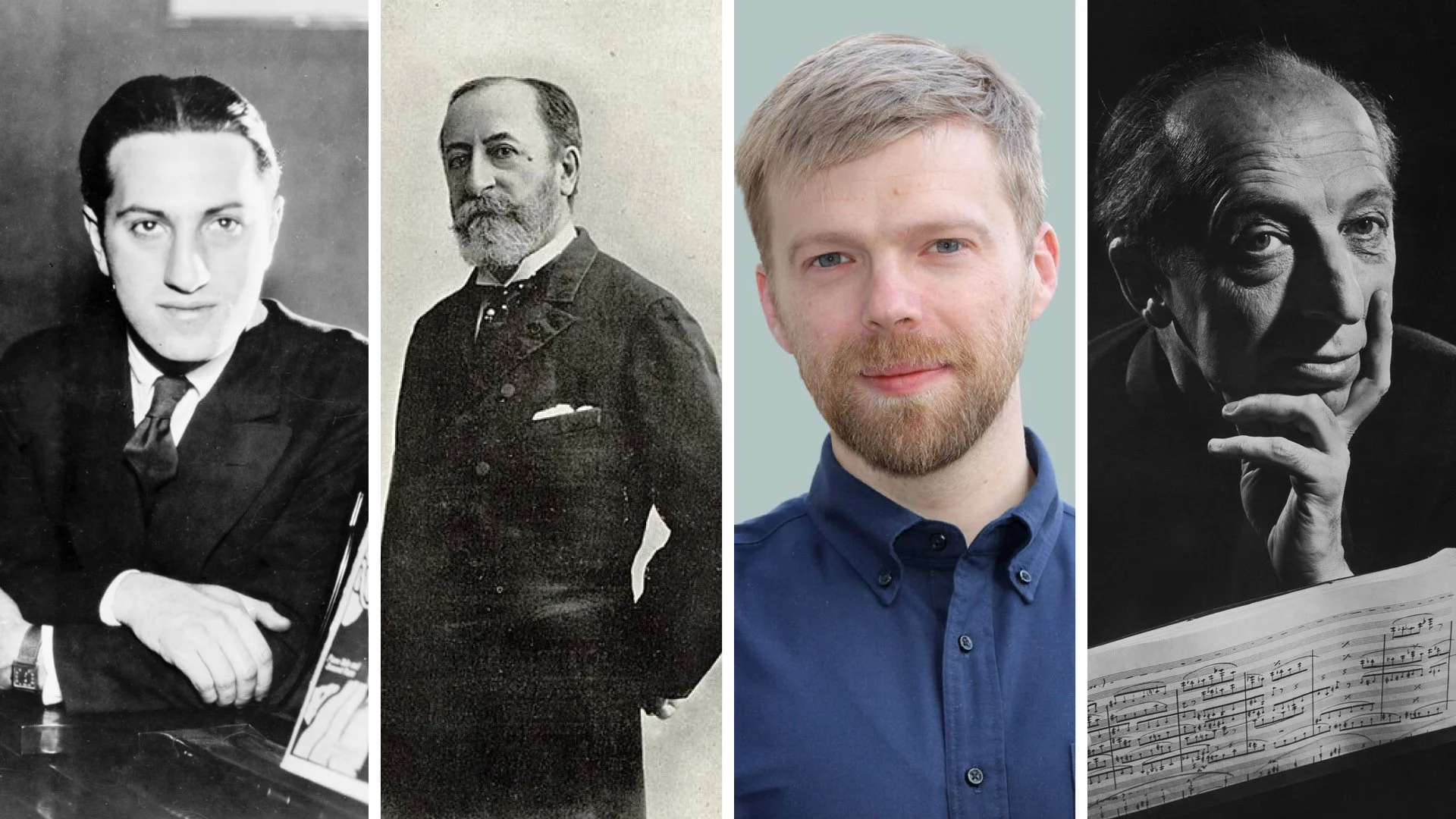
Gershwin (arr. Hersh): Three Preludes
Saint-Saëns: Carnival of the Animals
Norman: Drip Blip Sparkle Spin Glint Glide Glow Float Flop Chop Pop Shatter Splash
Copland: Four Dance Episodes from Rodeo
Program Notes for April 11 & 12, 2025
Carnival of the Animals

George gershwin
Three Preludes (arr. Hersh)

Composer: born September 26, 1898, Brooklyn, NY; died July 11, 1937, Hollywood, CA
Work composed: 1926, originally for solo piano. Dedicated to Gershwin’s friend and colleague Bill Daly
World premiere: Gershwin performed the three preludes at the Roosevelt Hotel in New York City on December 4, 1926.
Instrumentation: flute, oboe, clarinet, bassoon, 4 horns, trumpet, trombone, timpano, bass drum chime, glockenspiel, snare drum, suspended cymbal, tam-tam, triangle, vibraphone, woodblock, xylophone, and strings
Estimated duration: 6 minutes
After the success of Rhapsody in Blue made George Gershwin a household name, the young composer set himself the daunting task of writing 24 preludes for solo piano. He began early in 1925, but quickly abandoned the project, probably for lack of time. Between January 1925 and the premiere of Gershwin’s three preludes in December 1926, the composer wrote no less than four Broadway shows, made two trips to Europe, and composed and performed his Concerto in F with the New York Philharmonic.
These three concise, highly atmospheric pieces have become favorites with both musicians and audiences since their premiere. Arrangements for small orchestra, solo instruments and piano, particularly for violin, clarinet, and other winds, have proved as popular as Gershwin’s original versions. The first prelude centers on a distinctive blue note theme set to a syncopated jazz rhythm. Gershwin described the second prelude as “a sort of blues lullaby;” its languid melody suggests both fatigue and melancholy. The third piece, which Gershwin referred to as “the Spanish prelude,” combines a striking offbeat rhythmic motif with jazz-flavored melodies.
Camille Saint-saËns
Canival of the Animals

Composer: born October 9, 1835, Paris; died December 16, 1921, Algiers
Work composed: February 1886
World premiere: March 3, 1886, in a private concert hosted by cellist Charles Lebouc in Paris.
Instrumentation: 2 solo pianos, flute (doubling piccolo), clarinet, glass harmonica (or glockenspiel), xylophone, and strings
Estimated duration: 22 minutes
Camille Saint-Saëns occupies a pivotal place in the history of French music. His numerous compositions include works in every genre, and, stylistically, his music bridges the gap between Berlioz and Debussy. (Before Saint-Saëns, 19th-century French music was virtually synonymous with opera; Berlioz’ Symphonie fantastique is a notable, but isolated, exception.)
Through his many instrumental works, Saint-Saëns expanded the boundaries of French music to include a broad array of orchestral and chamber works, thus raising the profile of French music internationally.
Saint-Saëns wanted his music to outlive him, and to be remembered as a significant composer. Ironically, he is best known today for his Carnival of the Animals, a satirical “witty fantasy burlesque,” in the words of a colleague, and one he refused to have published during his lifetime, fearing it would tarnish his reputation as a writer of “serious” music. (Interestingly, Saint-Saëns also stipulated in his will that Carnival be published after his death; Durand brought out the first edition in 1922). Originally written for two pianos and chamber ensemble, Carnival of the Animals has delighted children and adults for more than a century. Excerpts from Carnival have also entered popular culture through classic cartoons, films, and television commercials.
In 1885, Saint-Saëns embarked on an extensive concert tour of Germany, but his well-publicized negative opinions on the music of Richard Wagner enraged German audiences, and many of Saint-Saëns scheduled concerts were abruptly cancelled. In January 1886, Saint-Saëns took himself off to an out-of-the-way Austrian village to rest and recover. While there, Saint-Saëns amused himself by writing a humorous, satirical suite, each movement depicting a different animal.
Musical jokes and well-known quotations from other works appear throughout Carnival, which opens with a glittering tremolo of an Introduction that gives way to the magisterial Royal March of the Lion, music befitting the all-powerful King of the Jungle. Saint-Saëns effectively captures the hither-and-thither bustle of Hens and Roosters darting about, pecking at seeds on the ground while the clarinet squawks the rooster’s crow. Both pianists execute a headlong gallop up and down the keyboard as Wild Donkeys race past. Saint-Saëns pokes fun at the Tortoises’ sluggish pace with a slowed-down-to-a-crawl version of the famous high-stepping theme of the French Can-Can. The Elephant waltzes to a gently lumbering tune in the double basses, accompanied by delicate flourishes from the pianos. The pianos jumping chords depict Kangaroos hopping here and there, pausing now and then to look around. In The Aquarium, lissome fishes swim through sun-dappled water, while the strings’ flowing melody hints at mysterious underwater realms, accented by sharp pings of the glockenspiel and the pianos’ sinuous accompaniment.
The bray of Donkeys is featured in the brief Characters With Long Ears. Next, the pianos establish a quiet forest scene for The Cuckoo, whose characteristic call is sounded by the clarinet. Flocks of colorful tuneful birds surround us in The Aviary, as the flute’s nimble fluttering evokes their breathless flights. In the original score, Saint-Saëns tells the Pianists to “imitate the hesitant style and awkwardness of a beginner,” as they play a series of tedious scales and other practice exercises. In Fossils, the only non-living animals in the Carnival, Saint-Saëns borrows from his own Danse macabre to portray Fossils dancing to the metallic staccato sound of the xylophone. Quotes from other well-known tunes including “Twinkle, Twinkle, Little Star,” the French children’s song “Au clair de la lune,” and a quick nod to an aria from Rossini’s Barber of Seville are also featured.
The Swan is the only movement from Carnival that Saint-Saëns allowed to be published during his lifetime, in an arrangement for piano and cello. The piano’s graceful, understated arpeggios support the cello’s fluid unbroken melody as the swan glides with seeming effortlessness over the waters of a still pond.
In the joyful Finale, Saint-Saëns reprises snippets from previous movements, as the animals celebrate. True to form, the Donkeys have the last word, hee-hawing the Carnival to a close.
When Carnival was published and publicly performed after Saint-Saëns death, it was hailed by all as an unqualified delight. The newspaper Le Figaro’s review was typical: “We cannot describe the cries of admiring joy let loose by an enthusiastic public. In the immense oeuvre of Camille Saint-Saëns, The Carnival of the Animals is certainly one of his magnificent masterpieces. From the first note to the last it is an uninterrupted outpouring of a spirit of the highest and noblest comedy. In every bar, at every point, there are unexpected and irresistible finds. Themes, whimsical ideas, instrumentation compete with buffoonery, grace and science …”
Andrew Norman
Drip, Blip, Sparkle, Spin, Glint, Glide, Glow, Float, Flop, Chop, Pop, Shatter, Splash

Composer: born October 31, 1979, Grand Rapids, MI
Work composed: Commissioned by the Minnesota Orchestra for their Young People’s Concert Series in 2005.
World premiere: Bill Schrickel led the Minnesota Orchestra in the premiere on November 2, 2005, in Orchestra Hall, Minneapolis, MN.
Instrumentation: piccolo, 2 flutes, 2 oboes, 3 clarinets, 2 bassoons, 4 horns, 3 trumpets, 3 trombones, tuba, timpani, brake drum, crotales, ratchet, snare drum, slapstick, tambourine, tam-tam, triangle, vibraphone, woodblock, xylophone, piano and strings
Estimated duration: 4 minutes
Andrew Norman is a composer, educator, and advocate for the music of others. Praised as “the leading American composer of his generation” by the Los Angeles Times, and “one of the most gifted and respected composers of his generation” by the New York Times, Norman has established himself as a significant voice in American classical music.
Norman’s music often takes inspiration from architectural structures and visual cues. His music draws on an eclectic mix of instrumental sounds and notational practices, and it has been cited in the New York Times for its “daring juxtapositions and dazzling colors,” and in the Los Angeles Times for its “Chaplinesque” wit.
Drip, Blip, Sparkle, Spin, Glint, Glide, Glow, Float, Flop, Chop, Pop, Shatter, Splash was conceived as a “get-to-know-you” piece to introduce young listeners to the multifaceted sounds of the orchestra. “The process of writing it was a bit like making a tossed salad,” says Norman. “I chopped up sounds from the orchestra – one sound for each of the thirteen verbs in the title – and then I tossed them all together and called it a piece.”
The four-minute work whizzes by with the hyperkinetic energy of a Tom & Jerry cartoon. Each word of the title is delightfully and recognizably embodied by myriad, disparate sounds, from a battery of percussion instruments to muted brasses to bows playing col legno (on the wood) and a single woodblock ticking with anticipatory hold-your-breath excitement. Audience members should note that the verbs of the title are not necessarily depicted in order, but are encouraged to identify each one nonetheless.
aaron copland
Four Dance Episodes from Rodeo

Composer: born November 14, 1900, Brooklyn, NY; died December 2, 1990, North Tarrytown, NY
Work composed: The ballet Rodeo, from which this suite of dances is adapted, was commissioned in 1942, by the Ballet Russe de Monte Carlo, with choreography by Agnes de Mille. Shortly after its premiere in October 1942, Copland arranged the Four Dance Episodes for orchestra.
World premiere: Alexander Smallens led the New York Philharmonic at the Stadium Concerts in July 1943
Instrumentation: 3 flutes (2 doubling piccolo), 2 oboes, English horn, 2 clarinets, bass clarinet, 2 bassoons, 4 horns, 3 trumpets, 3 trombones, tuba, timpani, bass drum, cymbals, orchestra bells, slapstick, snare drum, triangle, wood block, xylophone, harp, piano, celesta, and strings.
Estimated duration: 18 minutes
When choreographer Agnes de Mille approached Aaron Copland about collaborating on a new “cowboy ballet,” Copland was less than enthusiastic. Copland’s 1938 ballet about the outlaw Billy the Kid had already given the composer the opportunity to explore Western musical themes in his work, and he saw de Mille’s project as more of the same. But de Mille, then a young and largely unknown choreographer, convinced the skeptical Copland her ballet was sufficiently different from Billy the Kid – a basic, universally appealing story set against the epic sweep of the American West – and Copland eventually agreed.
De Mille’s scenario featured a tomboyish Cowgirl from Burnt Ranch who shows up the ranch hands by out-lassoing them while roping bucking broncos. She is drawn to the Head Wrangler, who takes little notice of her, despite her obvious skills as a cowboy, until she puts on a pretty dress and makes eyes at him at the Saturday night barn dance.
As he did in Billy the Kid, Copland makes use of several authentic cowboy songs. After a high-energy brass introduction, Buckaroo Holiday features the song “If He Be a Buckaroo by His Trade,” (trombone solo approximately halfway through the movement). In the gentle Corral Nocturne, Copland quotes the song “Sis Joe” (about a train named Sis Joe heading for California’s Gold Rush country). By slowing down the song’s usual tempo, Copland creates an intimate, wistful interlude that captures the Cowgirl’s loneliness. The relaxed, low-key Saturday Night Waltz features a famous cowboy song, “I Ride An Old Paint. Hoe Down is the most recognized movement from Rodeo, thanks to its use in a popular commercial advertising American beef. In the final scene of the ballet, at a boisterous hoe-down, the cowgirl appears in a party dress, and the cowboys finally notice her. After a rhythmic introduction, “Bonaparte’s Retreat,” “McLeod’s Reel,” and other square dances fill the air with foot-stomping, thigh-slapping tunes.
© Elizabeth Schwartz
NOTE: These program notes are published here by the Modesto Symphony Orchestra for its patrons and other interested readers. Any other use is forbidden without specific permission from the author, who may be contacted at www.classicalmusicprogramnotes.com

Program Notes: Gershwin's An American in Paris
Notes about:
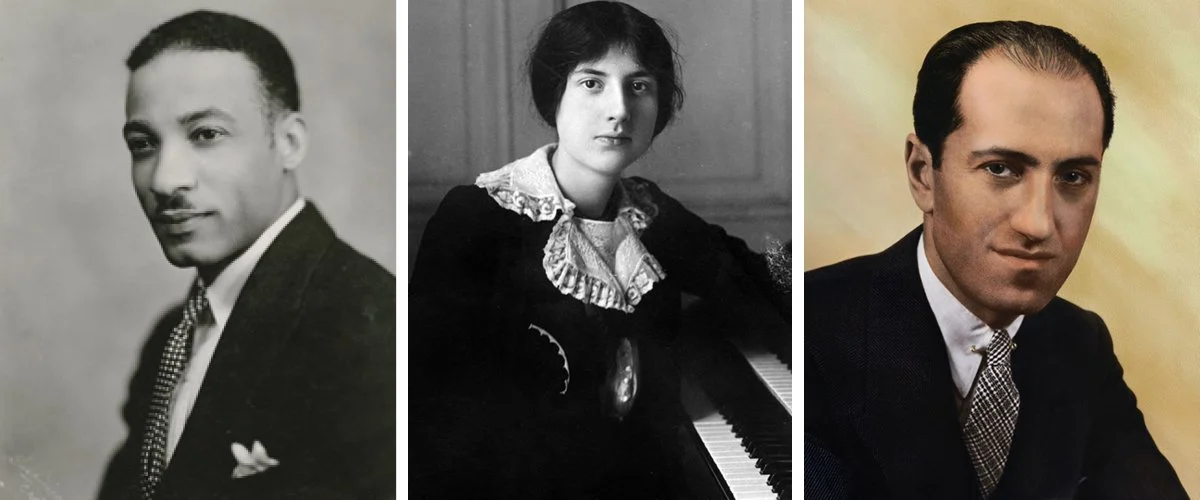
Dawson’s Negro Folk Symphony
Boulanger’s D’un Matin de Printemps
Gershwin’s An American in Paris
Program Notes for February 9 & 10, 2024
Gershwin’s An American in Paris


William dawson
Negro Folk Symphony

Composer: born September 26, 1899, Anniston, AL; died May 2, 1990, Montgomery, AL
Work composed: 1934, rev. 1952
World premiere: Leopold Stokowski led the Philadelphia Orchestra on November 20, 1934, at Carnegie Hall in New York City
Instrumentation: piccolo, 2 flutes, 2 oboes, English horn, 3 clarinets, bass clarinet, 2 bassoons, contrabassoon, 4 horns, 3 trumpets, 3 trombones, tuba, timpani, adawura (Ghanaian bell), African clave, bass drum, chimes, cymbals, gong, snare drum, tenor drum, xylophone, harp, and strings
Estimated duration: 30 minutes
“I’ve not tried to imitate Beethoven or Brahms, Franck or Ravel – but to be just myself, a Negro,” William Dawson remarked in a 1932 interview. “To me, the finest compliment that could be paid my symphony when it has its premiere is that it unmistakably is not the work of a white man. I want the audience to say: ‘Only a Negro could have written that.’”
Two years later, Leopold Stokowski led the New York Philharmonic in the premiere of Dawson’s Negro Folk Symphony. Critics and audiences alike hailed it as a masterpiece. One reviewer declared it “the most distinctive and promising American symphonic proclamation which has so far been achieved,” and another enthused, “the immediate success of the symphony [did not] give rise to doubts as to its enduring qualities. One is eager to hear it again and yet again.” Given this overwhelmingly positive reception, Dawson’s Negro Folk Symphony, which at the time he thought of as the first of several future symphonies, should have been heard “again and yet again.” But it was not. Despite Stokowski’s advocacy for Dawson and the Negro Folk Symphony, and despite the stellar reviews it received at its premiere, within a few years both the music and its composer had faded into relative obscurity. Dawson never composed another symphony, although he did continue writing and arranging music – primarily spirituals, which he preferred to call “Negro folk songs” – for the rest of his long career.
In the current climate of racial reckoning, Dawson’s Negro Folk Symphony is enjoying a long-overdue revival, as is the music of other Black classical composers such as Florence Price, William Grant Still, Nathaniel Dett, and many others.
Dawson wrote that his symphony was “symbolic of the link uniting Africa and her rich heritage with her descendants in America,” and gave each of its three movements a descriptive title. Dawson explained in his own program note: “The themes are taken from what are popularly known as Negro Spirituals. In this composition, the composer has employed three themes taken from typical melodies over which he has brooded since childhood, having learned them at his mother’s knee.” Musicologist Gwynne Kuhner Brown observes, “The themes are handled with such virtuosic flexibility of rhythm and timbre that each movement seems to evolve organically,” creating a “persuasive musical bridge between the ‘Negro Folk’ and the ‘Symphony.’”
In “The Bond of Africa,” Dawson opens with a horn solo. The dialogue between the horn and the orchestra echoes the call-and-response format of most spirituals. The horn solo repeats, usually in abbreviated form, several times throughout this movement, and serves as a musical “bond” holding the work together. The central slow movement, “Hope in the Night,” also features a unifying solo. Here an English horn sounds Dawson’s own spiritual-inspired melody, which he described as an “atmosphere of the humdrum life of a people whose bodies were baked by the sun and lashed with the whip for two hundred and fifty years; whose lives were proscribed before they were born.” Underneath the plaintive tune, the orchestra provides a dirge-like accompaniment that builds to an ominous repetition of the solo for tutti orchestra. This episode is offset by an abrupt change of mood, and we hear a lighthearted, up-tempo reworking of the original tune (the “hope” of the movement’s title). These two contrasting interludes alternate throughout the rest of the movement. Towards the end, Dawson reworks the harmony, which has been grounded in minor keys up to this point, and tiptoes towards major tonalities without fully embracing them. Musically, this device works as a powerful metaphor for the importance and elusive nature of hope to sustain people through traumatic circumstances.
The closing section, “Oh, Le’ Me Shine, Shine Like A Morning Star!” imagines a world in which the hopes of the previous movement are fully realized. Dawson creates this musical utopia through rhythm. The central melody showcases accented off-beat exclamations from various solo instruments and sections throughout, as the rhythms layer increasingly complex parts over one another. Dawson revised this movement in the early 1950s after he encountered the intricate polyrhythms of West African music during a trip to Africa. The interlocking parts and the sounds of African percussion instruments captured Dawson’s ear; when he returned to America, he added these elements. Eventually all these rhythmic strands come together in a final buoyant exclamation.
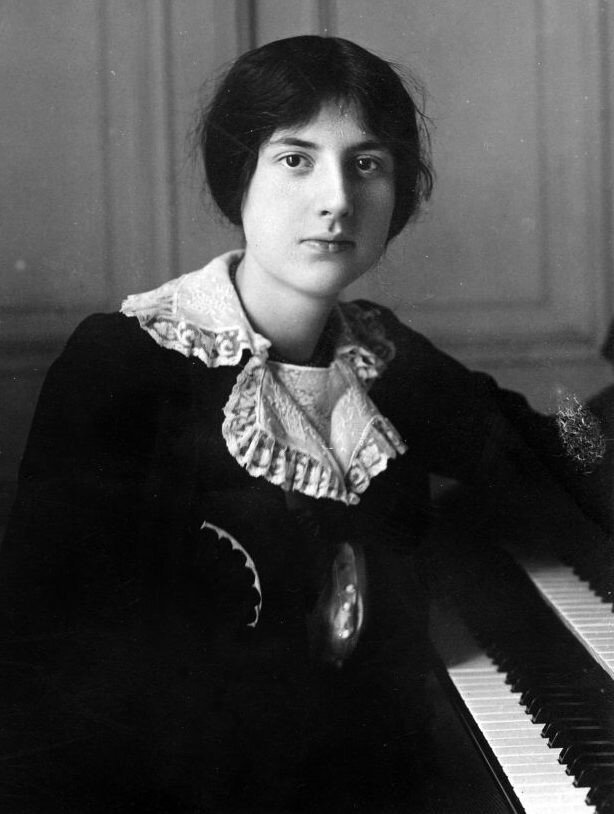
Lili Boulanger
D’un matin de printemps (From A Spring Morning)
Composer: born August 21, 1893, Paris; died March 15, 1918, Mézy-sur-Seine
Work composed: 1917-18. Boulanger made arrangements in multiple versions: for violin and piano, string trio, and full orchestra
World premiere: undocumented
Instrumentation: piccolo, 2 flutes, 2 oboes, English horn, 2 clarinets, bass clarinet, 2 bassoons, contrabassoon, 4 horns, 2 trumpets, 3 trombones, tuba, bass drum, castanets, cymbals, tambourine, tam-tam, timbales, triangle, celeste, harp, and strings
Estimated duration: 5 minutes
Women composers, like other female creative artists, have to fight battles their male counterparts do not. Even today, a female visual artist, writer, or composer is sometimes evaluated on criteria that have little or nothing to do with her work, and everything to do with her gender, her appearance, or her life circumstances. Lili Boulanger was no exception.
The younger sister of composer and pedagogue Nadia Boulanger, who taught composition to many of the 20th century’s most distinguished composers, Lili Boulanger revealed her enormous talent at a very young age. She was a musical prodigy born into a musical family; in 1913, at age 20, she became the first woman to win the coveted Prix de Rome, France’s most prestigious composition prize. Boulanger’s compositional style, while grounded in the prevailing impressionistic aesthetics associated with Claude Debussy, is nonetheless wholly her own. Her music features rich harmonic colors, hollow chords (open fifths and octaves), ostinato figures, running arpeggios, and static rhythms.
Along with her tremendous musical ability, Boulanger was born with a chronic, debilitating intestinal illness, probably Crohn’s disease. Today there are drugs and other therapies to manage this condition, but in Boulanger’s time the illness itself had neither name nor cure, and its treatment was likewise little understood. Throughout her short life, Boulanger suffered from acute abdominal pain, bouts of uncontrollable diarrhea, and constant fatigue; all these symptoms naturally impacted her stamina and her ability to write. Contemporary reviews of Boulanger’s work always emphasized her physical fragility, often in lieu of a thoughtful assessment of her music.
Despite illness, Boulanger continued composing, even on her deathbed. D’un matin printemps, the second half of a diptych that includes its shorter counterpart D’un soir triste (From a Sad Evening) are two of the last works she wrote. Both pieces treat the same opening melodic and rhythmic theme in different ways: in D’un soir triste, the tempo is slow and the mood elegiac, while the same melodic/rhythmic fragment receives a cheerful, puckish treatment in D’un matin printemps that sparkles with effervescence and youthful joy.
George gershwin
An American in Paris

Composer: born September 26, 1898, Brooklyn, NY; died July 11, 1937, Hollywood, CA
Work composed: March - June 1928, while Gershwin and his siblings were vacationing in Paris
World premiere: Walter Damrosch led the New York Philharmonic on December 13, 1928 in New York
Instrumentation: 3 flutes (1 doubling piccolo), 2 oboes, English horn, 2 clarinets, bass clarinet, 3 saxophones (alto, tenor, baritone), 2 bassoons, 4 horns, 3 trumpets, 3 trombones, tuba, timpani, bass drum, bells, cymbals, snare drum, taxi horns, tom-toms, triangle, xylophone, celesta, and strings
Estimated duration: 17 minutes
“My purpose here is to portray the impression of an American visitor in Paris, as he strolls about the city and listens to various street noises and absorbs the French atmosphere,” wrote George Gershwin about his tone poem, An American in Paris. “As in my other orchestral compositions, I’ve not endeavored to represent any definite scenes in this music. The rhapsody is programmatic only in a general impressionistic way, so that the individual listener can read into the music such as his imagination pictures for him,” This highly evocative, colorful symphonic music expertly captures the sights and sounds of Paris as its American protagonist wanders through the city streets. To illustrate the American’s journey, Gershwin included several of what he termed “walking themes,” which recur throughout the work. The trumpet sounds the most recognizable of these, the “homesick music,” in a bluesy solo. The “American” section concludes with an up-tempo Charleston played by a pair of trumpets, and the walking themes return. Finally, the orchestra winds up with a glittering exuberant finale as night falls on the City of Light.
An American in Paris marked a breakthrough for Gershwin as a composer, as the first symphonic piece for which he created his own orchestrations. When Rhapsody in Blue premiered in 1924, Gershwin was criticized because the Rhapsody’s orchestral version was created by Ferde Grofé. Four years after Rhapsody’s premiere, with An American In Paris, Gershwin demonstrated his growing command of orchestral colors, effectively silencing his detractors.
© Elizabeth Schwartz
NOTE: These program notes are published here by the Modesto Symphony Orchestra for its patrons and other interested readers. Any other use is forbidden without specific permission from the author, who may be contacted at www.classicalmusicprogramnotes.com
Enrich Your Concert Experience